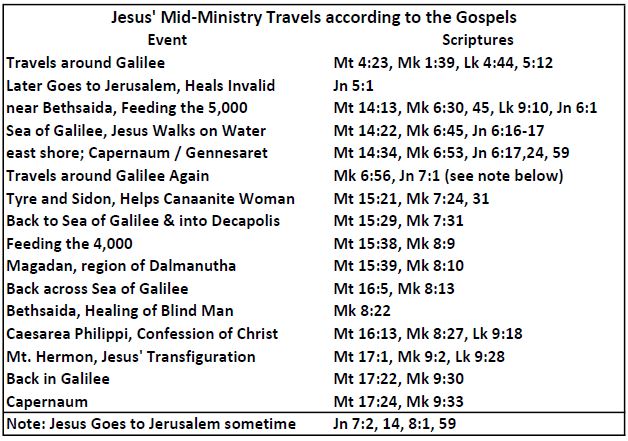
>1. Where had this large crowd who gathered around Jesus come from?
* Luke 6:17 "He went down with them and stood on a level place. A large crowd of his disciples was there and a great number of people from all over Judea, from Jerusalem, and from the coast of Tyre and Sidon,"
* The Sermon on the Plain recorded in Luke 6:17-49 is not the same event as the Sermon on the Mount recorded in Matthew 5:1-7:29. Most have tried to prove they are and weakly look at other's reasoning. I have to admit that coming to a conclusion on the matter is not easy. Some commentators say the conclusion is not that important. I believe it should not be so easily dismissed. Jesus' meaning as recorded by Luke is different than the sermon that Matthew records, though there are similarities. The commentates who state the two records are the same ignore Luke's account, claiming it simple and incomplete compared to Matthew's account. They share no or little commentary on Luke's account. Perhaps they grew weary of writing all the time and are looking forward to the end of writing. I can relate.
* Jesus main point in this sermon is what it means to be his disciple, his follower, and what should be the result of following him. Jesus is teaching what it means to be sent.
* "He went down with them" -Luke records this sermon took place right after Jesus "went down" the mountain with his newly chosen twelve apostles. The apostles (and perhaps more disciples for 13 says, "he called his disciples to him and chose twelve of them") walked down with him to where the large crowd had gathered. (Luke 6:12-16) Jesus lead the way down the mountain. This was the first lesson Jesus wanted his apostles to understand, learn, and practice. Matthew's event says Jesus "went up and sat down" another important difference in the two accounts. Luke's account is showing Jesus' first lesson to his newly appointed ambassadors.
One commentate does present an interesting combined scenario: Jesus prayed high on the mountain, call some disciples up to him, chose twelve of them, they walked down the mountain, Jesus attended to the people's requests and needs, Jesus walked a small ways back up the mountain later in the day, had his disciples either sit before him or sit with him, and he taught them with the crowd listening too but lower on the plain. While this seems plausible, it does not fully take into account Matthew's exact wording and timing in 4:23-5:2, and 8:1. We must note that Matthew does not record when Jesus first appointed the twelve, not even in his chapter 10. Chapter 10 is simply the first place Matthew records who the apostles were, the time that Jesus first sent them out.
Some commentators say that neither Matthew nor Luke are following exact chronological timing, though both put this very close to Jesus chosen the twelve, just not exactly at the same time. They say this because it is obvious that Matthew puts his account a few months after the choosing of the twelve, where Luke puts it directly after, if we accept they are in chronological order. Since they believe both accounts are the same event, they reconcile the timing difference by stating that neither Matthew and Luke are following chronological timing. However, to me, Luke and Matthew give enough defined differences for us to know that these are different events that took place several months apart, each having slightly different points, and both in chronological order. Jesus often repeated his teachings, both practical and verbal, and they too with different though similar emphasis.
* "stood on a level place" -The original Greek adjective for "level place" is "pedinos" which is translated into English as "level," "flat," or "pertaining to a plain." In this verse, the only appearance in the New Testament, "pedinos" modifies the Greek word for place, "topos", creating the phrase "topos pedinos", which is translated as "a level place" or "a plain." Luke's careful use of this word, which Greek root means "the foot of" designates it is the foot of the mountain that he had prayed all night on. Thus, Luke is stating this event is not the same as Matthew's account where Jesus stood on the side of a mountain. Matthew, unlike Luke, states in three verses before his account of the Sermon on the Mount that before it Jesus traveled all around Galilee before it. Luke is not stating that Jesus was not standing on a plateau, he was standing on the flat ground beyond the mountain. Jesus went down the mountain and healed on the spot just before he talked directly to his disciples. And yes, this is not the only subtle difference between the event recorded by Luke and the event recorded by Matthew.
* "A large crowd of his disciples was there" -More than the twelve and perhaps even more than the later picked 72 disciples. Large crowds were common. Matthew 15:38 16:10 and Mark 8:9, 20 record 4,000 at one event which included a miraculous feeding. Matthew 14:12, 16:9, Mark 6:44, 8:19 and John 6:10 record five thousand at another event which also included a miraculous feeding.
* "and a great number of people" -They came, but did not intend to follow Jesus. Luke records these people separate from his disciples.
* "from all over Judea" -Jesus was in Galilee. Judea was to the south. To Galilee's west was Gentile territory and beyond that was the vast desert.
* "from Jerusalem" -Jesus was in Galilee. Jerusalem was to the south, in Judea. South of Judea was a rocky desert with a few small oasis.
* "from the coast of Tyre and Sidon" -Jesus was in Galilee. Tyre was was to the northeast on the coast of the Mediterranean Sea.
* Matthew's account has some differences. His event has people coming from Galilee, the Decapolis, Jerusalem, Judea, and beyond the Jordan. All of these places are to the east, south-east, and south. None are in the direction of the Mediterranean Sea as Luke does. And Luke's event does not include anyone from the Decapolis and beyond the Jordan.
>Who was in the crowd?
* Luke 6:18-19 "who had come to hear him and to be healed of their diseases. Those troubled by evil spirits were cured, and the people all tried to touch him, because power was coming from him and healing them all."
* "who had come to hear him and to be healed of their diseases" -Those wanting to hear Jesus and/or be healed by Jesus came to Jesus. They were willing to travel long distances.
* "Those troubled by evil spirits were cured" -Evil spirits for one reason or another tend to trouble specific people again and again. They do not leave them alone. Usually these people through sin and rejecting God open themselves up to easier abuse from evil spirits. The evil spirit pick on the weak. The troubled soul is not without will. These people came to Jesus even though evil spirit continually and/or sporadically troubled them.
* "the people all tried to touch him" -Mark 14:36 records that when Jesus and his disciples had on another occasion crossed the Sea of Galilee and landed at Gennesaret, "people brought all their sick to him and begged him to let the sick just touch the edge of his cloak, and all who touched him were healed."
Later in his account Mark records in 6:56 that "wherever he went -- into villages, towns or countryside-- they placed the sick in marketplaces. They begged him to let them touch even the edge of his cloak, and all who touched him were healed." Then, in 8:22, "some people brought a blind man and begged Jesus to touch him." And a third time Mark records in 10:13, peple were bringing little children to Jesus to have him touch them..."
Luke will a second time record in 18:15, "People were also bring babies to Jesus to have him touch them," the same event as Luke had recorded.
* "because power was coming from him and healing them all" -The original Greek noun translated "power" by the NIV and others, and "virtue" by the KJV (a misunderstood outdated translation) is "dynamis" from which we get the English word dynamite. "Dynamis" means "force", specifically a miraculous power (and by implication a miracle).
>Who did Jesus address this message to?
* Luke 6:20a "Looking at his disciples" -Jesus addressed his disciples with all the commotion going on around him. Not only were people trying to touch him, but people were coming and going, trying to get his attention, shouting out, and pushing forward including the demon troubled. His disciples were there, close enough to look at. What were they to do? What were they doing? Crowd control? Since Jesus did heal people, Jesus was allowing the people to come forward. What crowd control could be done? It would not be easy, perhaps not as wanted as we think either. Then, Jesus stopped, looked at his disciples and began teaching them. What did the people do?
* Jesus had not been looking intentionally at his disciples until he was ready to speak to them. He waited for the right moment. When things were very chaotic it was time to say who was blessed. The people causing and in the chaos were blessed because they were frantic to get to Jesus.
*
Blessed Are You
Luke records a unique event, not to be confused with Matthew's record of the Sermon on the Mount which took place several months later. (Matthew 5:1-7:29) Luke's record of the Sermon on the Plain took place on flat ground within sight of the mountainside he had prayed all night on. When Jesus came down from the mountain, and after he chose twelve from the great crowd of disciples following him, Jesus was inundated with a great number of people from all over Judea, from Jerusalem, and from the coast of Tyre and Sidon. (See comments above for differences of Luke's and Matthew's records.)
Unlike the later events of the sermon on the side of the mountain, the feeding of the four thousand, and the feeding of the five thousand, Luke describes this event as more chaotic. Not only was a large crowd of disciples present, but also a great number of people had gathered from all over Judea, from Jerusalem, and from the coast of Tyre and Sidon. The great numbers were not part of the large crowd of disciples. These people had come, but had full intentions to leave once they got what they came for.
The group who came to Jesus and would leave, each had their own reasons for making their long journey to Jesus. Luke records them in general groupings; those who had come simply to hear him was is one. Then there were people who wanted to be healed. They had learned that merely touching Jesus would bring healing. The last group were those troubled by evil (unclean) spirits. They were people who the evil spirit would relentlessly torment. Each of these groups would be trying to get near enough to Jesus to either touch him or get his attention. The atmosphere of desperation and turmoil was the greatest the newly picked bewildered apostles had experienced. Later, they would learn mass crowd control. Here, Luke portrays them just standing there trying to comprehend what to do until Jesus looked at them and began his teaching by saying, "Blessed are you..."
Some scholars say that Matthew's account goes deeper than Luke's account, concluding and teaching others to ignore and/or consult Matthew for the full meaning behind what Luke records here. However, since Luke is recording a completely separate account, Jesus is making a slightly different point to his disciples.
Jesus called the 12 "apostles", meaning sent. Jesus is showing the apostles who he is sending them to. These people are the ones that are blessed. They are pressing forward to get near Jesus; to touch him, to be freed, and to hear him. They are blessed. Such people are moved by God to go to Jesus. Jesus sends his appointed to these kind of people
Listen to the above comments on Luke 6:17-20a.
* The oldest surviving pieces of the Gospel of Luke as of 2026 are Papyrus 4 and Papyrus 75, both dated to the late 2nd century or early 3rd century.
Key Early Luke, John, and Matthew Manuscripts
Papyrus 4. Late 2nd to early 3rd century -175-225 A.D. Contains extensive fragments from the opening chapters of Luke in Greek (such as Luke 1:58-6, 6:16) alongside portions of Matthew. It is housed in the Bibliothèque nationale de France.
Papyrus 75 (Papyrus Bodmer XIV-XV). Late 2nd to early 3rd century -175-225 A.D. A major Alexandrian codex in Greek containing a large portion of the Gospel of Luke (Luke 3:18-24:53) and parts of John. It is one of the earliest multi-gospel codices and is housed in the Vatican Library.
>2. From Jesus' point of view who are blessed?
* Luke 6:20b-23 "he said: "Blessed are you who are poor, for yours is the kingdom of God. Blessed are you who hunger now, for you will be satisfied. Blessed are you who weep now, for you will laugh. Blessed are you when men hate you, when they exclude you and insult you and reject your name as evil, because of the Son of Man. Rejoice in that day and leap for joy, because great is your reward in heaven. For that is how their fathers treated the prophets."
* Luke has four "blessed"s. Matthew has nine "blessed"s.
* "Blessed" -The original Greek is "makarios" (a transliteration) and in Hebrew its "slstopd" which means; "supremely blessed; fortunate, well off, happy." The YLT uniquely uses the English word "happy", an acquitted, though simple translation. The Mosaic Law started with a curse, but the New Testament Law starts with blessings.
* "Blessed are you who" -Jesus' four blessed statements as recorded by Luke begin the same with "...are you who" (KJV "...be ye" and ASV "...are ye"). Only one in Matthew's account begin this way; the rest begin with the abrupt, "Blessed are..." Luke's Greek does not contain the articles "...are you who"; however it is implied.
*
Poor
Jesus first told his disciples, "Blessed are you who are poor." Luke does not record Jesus saying "poor in spirit". "Poor" is the way the Holy Spirit wants us to consider it in this teaching. Matthew's account is another event and another teaching subject. He recorded, "poor in spirit", not Luke. (See comments above.) The original Greek adjective for "poor" is "ptochos", and what Aramaic word Jesus used does not matter because the oldest scripts the Spirit gives is in Greek. The root to "ptochos" is "ptosso" which means "to crouch" as in begging, and therefore these people are known by others to be in momentary need and in distress from time to time.
Jesus was poor, the disciples were poor, many if not all of the people who came that day and Jesus helped, were poor. How can their poverty be determined beyond Jesus' actions before he made this statement, and when he made the statement? Israel was a poor nation dew to heavy taxation by Rome, Herod, and the religious party. Wealth was concentrated to a small group of people. Therefore, most who came to Jesus that day were poor.
First, Jesus is teaching the disciples, especially his newly appointed apostles, that though these people are poor and thus have nothing to offer him, Jesus helped them. He expected nothing and he asked for nothing in return for his help. The disciples were being sent and expected them to do the same as he. Not to expect anything in return.
Second, Jesus continued his teaching by saying, "for yours is the kingdom of God." He said, "is"; that is present tense, not future tense. Jesus is not speaking of all poor. Rather, he is speaking of the poor who came to him in need that day for his help. These people had faith in Jesus. They left home and traveled far because they had faith that Jesus would help him. They were monetarily poor, but rich in faith just as many others in the Bible. James 2:5 is an exact record of this day, poor having faith in Jesus and being blessed.
The gift is the kingdom of God. The kingdom of God is where God rules. The kingdom of God is his people. His people believe. His people hope in him. His people's home is Jesus. His people love him. His people are blessed.
Listen to the above comments on Luke 6:20b.
* "hunger now" -The two original Greek words is the verb "peinao" and the adverb "nyn" meaning in the present, the here and now. "Peinao" has the root "penes" which means "to toil for daily subsistence". The people who came to Jesus work hard every day but the Sabbath to get enough to eat everyday and can achieve little more for they have nothing left when they buy their food. Even then, some days after they eat, they remained hungry.
*
Hunger
Jesus' next blessing declaration concerns those who hunger now. Luke does not record Jesus saying "hunger for righteousness" as Matthew does in his record of a separate event. "Hunger" for food is the way the Holy Spirit wants us to consider it in this teaching. Matthew's account is another event and another teaching subject (See comments above.) The root to the original Greek word is "penes" which means "to toil for daily subsistence". The people who came to Jesus that day worked hard every day but the Sabbath to get enough to eat everyday and can achieve little more for they have nothing left when they buy their food. Even then, some days after they eat, they remained hungry. They gave their children enough, but some day they didn't get enough food and could have eaten more.
Israel was a heavily tax poverty nation. The Roman's taxed the average person. Herod taxed them. The Sanhedrin expected special offerings beyond tithing. They instituted temple taxes, synagogue taxes, extra fees while purchasing offerings, mission offerings, and anything else they could invent. What remained was barely enough to buy food for their family to eat.
Jesus' disciples often find themselves so hungry that they had to eat grain set aside for the poor. Jesus also must have experience the same as he and his disciples traveled from city to village through open country. Traveling by foot make men hungry. The people Jesus sent his disciples to where people who experienced hunger from time to time just as they did.
Jesus continued his teaching by saying, "for you will be satisfied". Jesus was teaching his disciples. As they followed him and as they obeyed his calling to go forth they would be hungry, but they would be satisfied as well. The Greek word Luke used for satified is the same work he used at the feeding of the 5,000 when he said the people "ate and had their fill". It literally means "completely stuffed". The text is future. Though hungry now, in the future they will be completely full.
The apostle John records an event when Jesus and the disciples went into Samaria. While stopping by a well. Jesus sent the disciples into the town to buy some food because they were hungry for they were traveling. Jesus stayed by the well. A woman came. He revealed to her that he was the Messiah. She believed and went back into the town and told everyone. When the disciples came back with the food Jesus told them, "I have food to eat that you know nothing about. My food is to do the will of him who sent me and to finish his work." (John 4:32, 34) Jesus was satisfied even though he had no physical food up until that time.
Listen to the above comments on Luke 6:21a.
* "weep now" -The two original Greek words is the verb "klaio" and the adverb "nyn" meaning in the present, the here and now. The root to the original Greek word is "klaio" which means "to wail aloud", not cry silently. It was regularly used in the ancient Greco-Roman and Jewish worlds for mourning the dead, expressing deep emotional distress, or crying out in response to life's trials and injustices. The people who came to Jesus that day experienced deep sorrow, suffering, and hardship in this broken world.
Matthew 5:4 original Greek is the verb "pentheo" which is translated "morn" and means to mourn, lament, or grieve deeply with a profound, soul-felt sorrow. It is the strongest Greek word for sorrow, describing an acute, active state of mourning rather than a passive or light sadness. Historically and in biblical usage, it often described the heavy grief of standing beside a grave, wailing, or weeping openly over the loss of a loved one. In the context of the Beatitudes and the broader New Testament, "pentheo" extends beyond bereavement to encompass heartfelt remorse, repentance, and grief over personal and collective sin (and a few times over death).
*
Weep
Jesus next blessing declaration concerns those who weep now. Luke does not record Jesus saying in this teaching "mourn" as he does in Mathew's record of a separate event. (Matthew 5:4) Matthew uses a different Greek verb, one that refers to grief over sin. Here, the Greek verb translated as "weep" is the way the Holy Spirit wants us to consider it in this teaching. Matthew's account is another event and another teaching subject (See comments above.) The original Greek word is "gelao" which means "to wail aloud", a stronger emotion than crying silently or being melancholy. It was regularly used in the ancient Greco-Roman and Jewish worlds for mourning the dead, expressing deep emotional distress, or crying out in response to life's trials and injustices. The people who came to Jesus that day experienced deep sorrow, suffering, and hardship in this broken world.
On two separate occasions Jesus saw the large crowds that constantly gathered because they wanted to be by Jesus, just like this crowd. Jesus had compassion on them because they were like sheep without a shepherd. So he took care of their needs and taught them many things. (Matthew 9:36, Mark 6:34) These people wept. Jesus wanted his disciples, especially his newly picked apostles, to know that he was sending them to people who shed tears and wailed because they are oppressed, afflicted, and oppressed. Jesus would later tell Peter after he denied him, "Take care of my sheep". Jesus said this three times.
When Jesus began his ministry he purposely read these words from the prophet Isaiah, "The Spirit of the Lord is on me, because he has anointed me to preach good news to the poor. He has sent me to proclaim freedom for the prisoners and recovery of sight for the blind, to release the oppressed, to proclaim the year of the Lord's favor." (Luke 4:18-19) Jesus practically showed his disciples he cares for these weeping people.
Jesus continued his teaching by saying, "for you will laugh". As with the previous blessing this is future tense. This laughter is a sign of joy and/or satisfaction, the physical expression of laughter, mirth, or cheer. Due to a contrast to weeping in this life's trouble, this laughter symbolizes divine comfort, ultimate vindication, and a wellspring of belly laughter that replaces past sorrow and grief.
Jesus promises that though his people weep now, they will laugh in his kingdom. Revelation 19:6-8 states, "Then I heard what sounded like a great multitude, like the roar of rushing waters and like loud peals of thunder, shouting: "Hallelujah! For our Lord God Almighty reigns. Let us rejoice and be glad and give him glory! For the wedding of the Lamb has come, and his bride has made herself ready. Fine linen, bright and clean, was given her to wear." (Fine linen stands for the righteous acts of the saints.)"
* "when men hate you, when they exclude you and insult you and reject your name as evil"
* "because of the Son of Man"
>What are the rewards of the blessed?
* "for yours is" -The original Greek phrase is "hoti" (a transliteration), a conjecture translated as "for"; "hymeteros" (a transliteration), a pronoun, and "esti", a verb -third person singular present presumed indicative of "eimi", the first person singular present.
* "the kingdom of God" -Repeated many times in the Bible, especially in the Gospel of Luke. (i.e. 4:43, 7:28, 8:1, 8:10, 9:2, 11, 27, 60, 62, etc.) See other places for more commentary.
* "for" -The original Greek is "hoti" (a transliteration), a conjecture.
* "you will be satisfied" -The English phrase is one word in Greek, the verb "chorazo" (a transliteration). It literally meant in the first-century "to feed, fatten, gorge, or satisfy completely with food". In classical Greek writings, "chortazo" was used almost exclusively for cattle and beasts of burden. It described letting animals loose in a lush pasture to eat their absolute fill, or stuffing them at a feed trough until they were entirely gorged and physically bloated. By the first century AD, the word had expanded colloquially to apply to people. However, it retained its rustic, intense connotation. It did not mean politely eating a small meal; it meant eating one's fill until bursting or being fully satiated. For example, the Gospel writers used this exact word to describe what happened to the crowds after Jesus multiplied the loaves and fishes, "they all ate and were filled" (Luke 9:17).
* "you will laugh" -The English phrase is one word in Greek, the verb "gelao" (a transliteration). This laughter is a sign of joy and/or satisfaction, the physical expression of laughter, mirth, or cheer. Due to a contrast to weeping in this life's trouble, this laughter symbolizes divine comfort, ultimate vindication, and a wellspring of belly laughter that replaces past sorrow and grief.
* "because great is your reward in heaven"
* "For that is how their fathers treated the prophets"
>From Jesus' point of view who are the miserable people?
* Luke 6:24-26 "But woe to you who are rich, for you have already received your comfort. Woe to you who are well fed now, for you will go hungry. Woe to you who laugh now, for you will mourn and weep. Woe to you when all men speak well of you, for that is how their fathers treated the false prophets."
* The four counters, woes, in verse 24-26 to the four blesseds in verses 20b-23 are not in Matthew. Yet another example that Luke and Matthew are writing on different events and different, though similar, subjects. Those who believe the two are the same see that Matthew does not have the woes. They hold on to their belief, stating Matthew omitted the woes, while at the same time stating Luke wrote the shorten inferior version, a contradiction. They have little to say about the woes. If they would look closer at them they would see they counter and fully define the blessings and thus realize that Luke's record of Jesus' blessing teachings here are different than in Matthew's recorded event.
These counters solidify the meanings of poor, hunger, weep, hate, exclude, insult, and reject as evil.
* "But woe to you" -"But" is the Greek adverb/conjunction "plen". "Woe" is the interjection "ouai" and in the New Testament it functions more as a dramatic expression of alarm and grief-akin to warning someone they are walking straight into a disaster than a curse.
"to you" is the Greek pronoun "hymin". Of the over six hundred times it is used in the New Testament it is always translated "you".
* "who are rich -The English phrase is one word in Greek, the adjective "plousios" (a transliteration). It is used 28 times in the New Testament and always translated "rich" meaning wealthy, figurative "abounding with".
* "who are well fed now"
* "you who laugh now"
* "when all men speak well of you"
>What is in their future?
* "for you have already received your comfort" -"Comfort" or "consolation" is the Greek noun "paraklesis". It refers to ease, relief, or a sense of well-being that dulls or satisfies a person's longings. In the first century it covered a range of meanings from a legal or personal appeal to deep emotional comfort and relief.
* "for you will go hungry"
* "for you will mourn and weep"
* "that is how their fathers treated the false prophets"
>3. How is Jesus' viewpoint different from the viewpoint of worldly people?
* What the world says will make you happy, Jesus says makes us miserable. What the would says makes us miserable, Jesus said will make us complete.
* "Rejoice in that day and leap for joy"
>How can we have Jesus' viewpoint?
* Be one with him in Spirit.
II. Love Your Enemies (27-36)
>4. How does Jesus define "enimies"?
* Luke 6:27-28 "But I tell you who hear me: Love your enemies, do good to those who hate you, bless those who curse you, pray for those who mistreat you."
* "But I tell you who hear me"
* "Love your enemies"
* "do good to those who hate you"
* "bless those who curse you"
* "pray for those who mistreat you"
* "hate you... curse you... mistreat you"
* "love... do good to... pray for"
>How should a disciple show love practically in each encounter with one who has acted like an enemy?
* Luke 6:29-31 "If someone strikes you on one cheek, turn to him the other also. If someone takes your cloak, do not stop him from taking your tunic. Give to everyone who asks you, and if anyone takes what belongs to you, do not demand it back. Do to others as you would have them do to you."
* "If someone strikes you on one cheek, turn to him the other also."
* "If someone takes your cloak, do not stop him from taking your tunic."
* "Give to everyone who asks you"
* "if anyone takes what belongs to you, do not demand it back."
* "Do to others as you would have them do to you."
>5. What kind of reward should a disciple expect from acting in love toward enemies?
* Luke 6:32-36 "If you love those who love you, what credit is that to you? Even 'sinners' love those who love them.
33 And if you do good to those who are good to you, what credit is that to you? Even 'sinners' do that.
34 And if you lend to those from whom you expect repayment, what credit is that to you? Even 'sinners' lend to 'sinners,' expecting to be repaid in full.
35 But love your enemies, do good to them, and lend to them without expecting to get anything back. Then your reward will be great, and you will be sons of the Most High, because he is kind to the ungrateful and wicked.
36 Be merciful, just as your Father is merciful."
* "'sinners'"
* "what credit is that to you?"
* "Then your reward will be great"
* "you will be sons of the Most High"
>Why is it important to know this?
* "because he is kind to the ungrateful and wicked"
* "Be merciful, just as your Father is merciful."
* This kind of witness will move the hearts of our enemies. They won't expect it. They will see that we are different.
III. Do Not Judge Others (37-42)
>6. What are the practical reasons given by Jesus why disciples should not judge others?
* Luke 6:37-38 "Do not judge, and you will not be judged. Do not condemn, and you will not be condemned. Forgive, and you will be forgiven. Give, and it will be given to you. A good measure, pressed down, shaken together and running over, will be poured into your lap. For with the measure you use, it will be measured to you."
* "Do not judge... condemn..."
* "you will be"
* "Forgive"
>7. What is the main point of Jesus' discipleship?
* Luke 6:39-40 "He also told them this parable: "Can a blind man lead a blind man? Will they not both fall into a pit? A student is not above his teacher, but everyone who is fully trained will be like his teacher."
* Jesus wants us to love like God loves. He wants us to be like him.
>8. Why are we not qualified to judge others?
* Luke 6:41-42 "Why do you look at the speck of sawdust in your brother's eye and pay no attention to the plank in your own eye? How can you say to your brother, 'Brother, let me take the speck out of your eye,' when you yourself fail to see the plank in your own eye? You hypocrite, first take the plank out of your eye, and then you will see clearly to remove the speck from your brother's eye."
* We are sinful. We do not know all the facts. We often mistake truth for a lie, and a lie for the truth. We judge without knowing all the facts. Our past often clouds our judgment. We often ignore the truth.
>What must we do in order to have sufficient spiritual discernment to help others?
* "first take the plank out of your eye, and then you will see clearly to remove the speck from your brother's eye."
>What does it mean to take a plank out of one's eye?
* "plank" -Plank here is our sinful nature, our sinful habits, and the results of sin.
* Sin distorts our view.
* A hypocrite can never judge correctly.
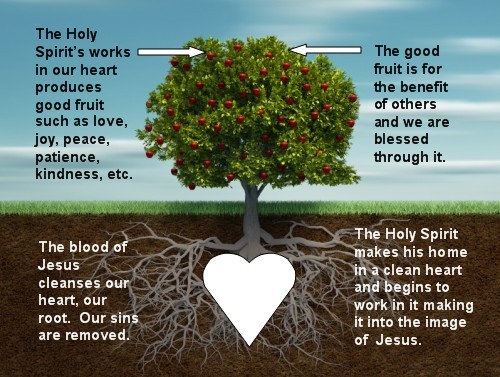
>9. What is necessary if a disciple's life is to bear the fruit which Jesus demands? (43-45)
* Luke 6:43-45 "No good tree bears bad fruit, nor does a bad tree bear good fruit. Each tree is recognized by its own fruit. People do not pick figs from thornbushes, or grapes from briers. The good man brings good things out of the good stored up in his heart, and the evil man brings evil things out of the evil stored up in his heart. For out of the overflow of his heart his mouth speaks."
* "No good tree bears bad fruit"
* "nor does a bad tree bear good fruit"
* "Each tree is recognized by its own fruit."
* "The good man brings good things out of the good stored up in his heart""
* "the evil man brings evil things out of the evil stored up in his heart."
* "For out of the overflow of his heart his mouth speaks."
IV. A Wise Man and a Foolish Man (46-49)
>10. What does Jesus' parable about the wise and foolish builders teach his disciples about how to grow spiritually?
* Luke 6:46-47 "Why do you call me, 'Lord, Lord,' and do not do what I say?
47 I will show you what he is like who comes to me and hears my words and puts them into practice."
*
*
*
*
>What must be a disciple's attitude towards Jesus words?
* Luke 6:48-49 "He is like a man building a house, who dug down deep and laid the foundation on rock. When a flood came, the torrent struck that house but could not shake it, because it was well built.
49 But the one who hears my words and does not put them into practice is like a man who built a house on the ground without a foundation. The moment the torrent struck that house, it collapsed and its destruction was complete."