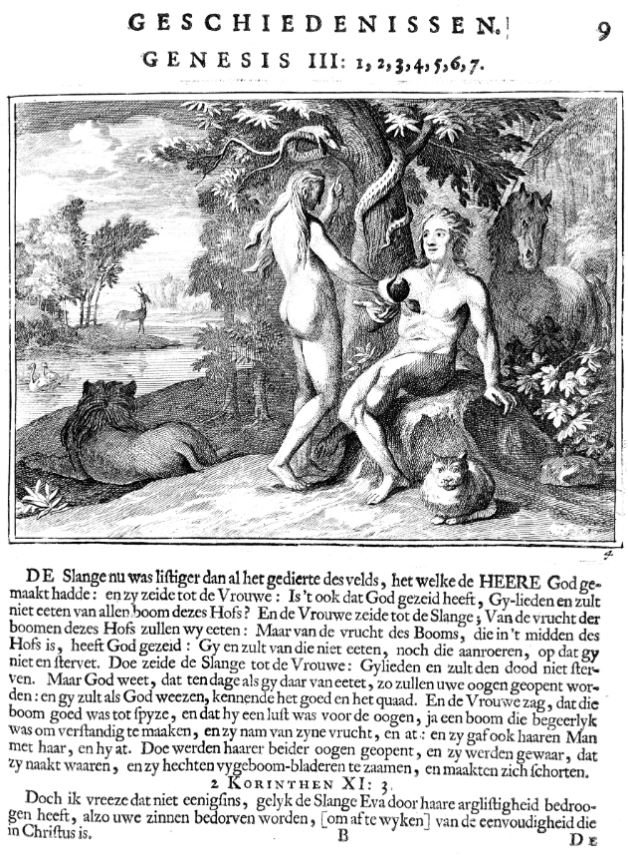
* The artwork "Man Tempted" is from a book by Luiken, Jan (1649-1712). It's title, in early modern Dutch, is, "De schriftuurlyke geschiedenissen en gelykenissen van het Oude en Nieuwe Verbond / Vertoonende drie honderd zeven en dertig konstige figuuren ; verrykt met bybelse verklaaringen en stichtelyke verzen, door Joannes Luiken, met het leven van den dichter". Translated into English it is, "The Scriptural Histories and Parables of the Old and New Testament / Depicting three hundred and thirty-seven artful figures; enriched with biblical explanations and edifying verses, by Joannes Luiken, with the life of the poet". Its now in public domain.
Adam receives the forbidden fruit from Eve. Courtesy of the Digital Image Archive, Pitts Theology Library, Candler School of Theology, Emory University.
>1. How does Paul consider his comments about himself in this letter? (1)
* 2 Corinthians 11:1 "I hope you will put up with a little of my foolishness; but you are already doing that."
*
Chapter 11 Overview.
No doubt, Paul did not have a humdrum, normal, easy life. He endured what I, like all humans, want to avoid. Why did he press on with his assigned ministry of reconciliation? Because of his love for God and God's people, and because he had a healthy fear of God. Jesus said his people would suffer for his namesake. (John 15:21) I should know things like these will happen to all who call on the name of Jesus.
Paul, several times in this chapter, stated his repulsion to boasting. Yet, he found the need to boast because the Corinthian congregation was listening to others who were impressive on the outside, and cunningly preached a false Jesus, a false gospel, and offered a counterfeit spirit. Just because a preacher or denomination uses the name of Jesus doesn't mean what they say and do is godly and true. Satan can masquerade as an angel of light (14), meaning he can look impressive while he leads people away from the truth straight into the hell where he will be cast (Revelation 20:1-3).
Sometimes God's people endure persecution and hardship in the name of Jesus. They hold on to the faith and keep to the gospel of reconciliation. Those who deceive look impressive, but as Jesus said, "They are whitewashed tombs, which look beautiful on the outside but on the inside are full of dead men's bones and everything unclean." (Matthew 23:27) I learn not to be as foolish as a deer and run into everything that shines.
Listen to the above Chapter 11 Overview.
* Paul has more to say in the epistle about his ministry and the charges of false religionists opposing him. We have seen in the previous lesson how the last two verses of chapter 10 conclude the message of the chapter. It may be noted here that the same two verses introduce the two subjects to be expanded in the passages of this lesson and the one that follows. These two subjects are glory (10:17) and approval (10:18). The passages dealing with them are:
11:1-15 True and False Apostles -Approval
11:16-12:13 What Paul Gloried In -Glory
It is from passages like these that we learn that although the opposition partly against Paul was a small minority in the Corinthian church, it was a formidable one. Paul was wise enough to know that evil begets evil -quickly, thoroughly, and destructively, So he spared no words in this part of his letter to expose the false apostles and reasure that faithful Corinthians of his own divinely approved credentials. As we have noted before, Paul wanted his forthcoming visit to be a success. (2 Corinthians, A Self-Study Guide. Irving L. Jensen, Moody Press, The Moody Bible Institute of Chicago. 1972 Used by permission.)
* Only the KJV starts verse 1 with "Would to God..." No Greek word for God exists in the original texts. Hence, all other translations do not include it.
* "I hope" -A way to ask for grace for being foolish.
* "foolish" -The contrasting elements of wisdom and folly evident in the Old Testament were clearly in the mind of Paul when he asked, "hath not God made foolish the wisdom of this world?" (1 Cor. 1:20b). However, in the New Testament, this polarity between wisdom and folly is not always stressed. In fact, it is possible that a certain kind of wisdom can actually be folly. In Matthew 7:26; 25:2,3; Romans 2:20 "folly" is used synonymously with "experiential wisdom." Wisdom based only on human intellect and experiences without considering God is folly. (Holman Bible Dictionary)
* While it is true that Paul was not lying, he was drawing attention to himself and his works. The reason why this is wrong in most cases is because God is the one that makes it all happen. He gives us the ability. He orchestrated all the events that make the time possible. God brought it all together. He provided all that was needed. Sure, we have to be willing and often we have to learn skills and provide effort, but considering all that God does, we do practically nothing.
* 2 Corinthians 12:6 "Even if I should choose to boast, I would not be a fool, because I would be speaking the truth. But I refrain, so no one will think more of me than is warranted by what I do or say."
>What did he consider foolish? (2 Cor. 10:8, 14)
* 2 Corinthians 10:8 "For even if I boast somewhat freely about the authority the Lord gave us for building you up rather than pulling you down, I will not be ashamed of it."
* 2 Corinthians 10:14 "We are not going too far in our boasting, as would be the case if we had not come to you, for we did get as far as you with the gospel of Christ."
* "you will put up with a little of my foolishness" -Paul's foolishness is boasting to compare his own ministry w ith that of the false apostles and teachers who have invaded the Corinthian congregation. The boasting by itself would be a foolish thing. However, it has a purpose.
* "but you are already doing that." -He acknowledges their former "putting up" with him in gracious patience.
>Why would he be foolish? (2)
* 2 Corinthians 11:2 "I am jealous for you with a godly jealousy. I promised you to one husband, to Christ, so that I might present you as a pure virgin to him."
* "I am jealous for you with a godly jealousy." -He doesn't want a false prophet or teach to steal them away. This implies much about a right and wrong understanding about salvation from sin, death, and condemnation. The image is we must remain pure. Jesus told Peter and the rest of the apostles after he washed their feet during the Last Supper that they were clean, only their feet were dirty and needed washing. They were not pure, but he would purify them. The same concept is here. Paul wants the believers at Corinth to remain pure until they stand before the judgment seat of Christ upon his return.
* "I promised you to one husband, to Christ," -Paul is portraying himself like father of the bride, a bride's maid, or a best man. John the Baptist did the same.
* "so that I might present you as a pure virgin to him." -In Christian marriages, the father gives his daughter away. A Jewish wedding doesn't include this ceremony, though he may accompany her. The act of giving away is purely Christian.
>What does it mean that Jesus is our husband?
* "one husband, to Christ" -Jesus used the analogy of himself being the groom and his people being his bride. This image is also in the Old Testament, where the Lord is the broom and Israel his bride and wife.
* "so that I might present you" -He will present those who believed because of his witness to Christ. Previously he spoke of bragging before Christ about their faith. The image here is the same.
* "as a pure virgin to him" -Pure meaning without sin.
* Isaiah 61:10 "I delight greatly in the LORD; my soul rejoices in my God. For he has clothed me with garments of salvation and arrayed me in a robe of righteousness, as a bridegroom adorns his head like a priest, and as a bride adorns herself with her jewels."
* Isaiah 62:5 "As a young man marries a maiden, so will your sons marry you; as a bridegroom rejoices over his bride, so will your God rejoice over you."
* Matthew 9:15 (Also Mark 2:19-20 and Luke 5:34-35) "Jesus answered, 'How can the guests of the bridegroom mourn while he is with them? The time will come when the bridegroom will be taken from them; then they will fast.'"
* Matthew 25:1-5 "At that time the kingdom of heaven will be like ten virgins who took their lamps and went out to meet the bridegroom. Five of them were foolish and five were wise. The foolish ones took their lamps but did not take any oil with them. The wise, however, took oil in jars along with their lamps. The bridegroom was a long time in coming, and they all became drowsy and fell asleep."
* John 3:27-30 "To this John replied, 'A man can receive only what is given him from heaven. You yourselves can testify that I said, 'I am not the Christ but am sent ahead of him.' The bride belongs to the bridegroom. The friend who attends the bridegroom waits and listens for him, and is full of joy when he hears the bridegroom's voice. That joy is mine, and it is now complete. He must become greater; I must become less.'"
* Betroth means to promise "by one's truth." Men and women were betrothed when they were engaged to be married. This usually took place a year or more before marriage. From the time of betrothal the woman was regarded as the lawful wife of the man to whom she was betrothed (Deut 28:30; Jdg 14:2, 8; Mat 1:18-21). The term is figuratively employed of the spiritual connection between God and his people (Hos 2:19, 20). (Illustrated Bible Dictionary: And Treasury of Biblical History, Biography, Geography, Doctrine, and Literature)
* Betrothal was the act of engagement for marriage in Bible times and was as binding as marriage. Old Testament-Gen. 19:14; Ex. 22:16; Deut. 22:23-30; 2 Sam. 3:14; Hos. 2:19-20. New Testament-Matt. 1:18; Luke 1:27; 2:5. (Holman Bible Dictionary. This has more seperating comments for the Old Testament and the New Testament.)
* Smith's Bible Dictionary has within its commentary on marriage has content related to betrothal that I will not cite. However, I do include this, "The allegorical and typical allusions to marriage have exclusive reference to one object, viz., to exhibit the spiritual relationship between God and his people. In the Old Testament Isai 54:5; Jere 3:14; Hose 2:19 In the New Testament the image of the bridegroom is transferred from Jehovah to Christ, Matt 9:15; John 3:29 and that of the bride to the Church, 2 Cor 11:2; Reve 19:7; 21:2, 9 (Smith's Bible Dictionary: Comprising Antiquities, Biography, Geography, Natural History, Archaeology and Literature)
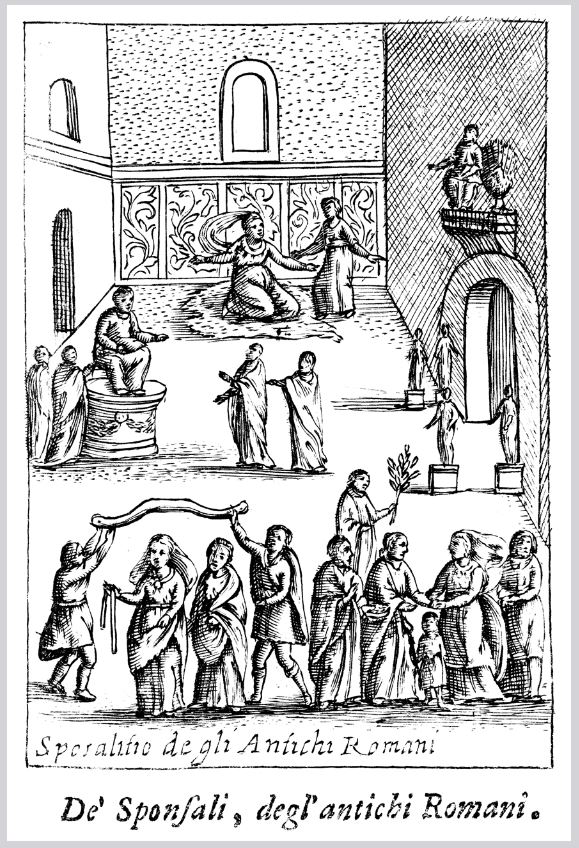
* The artwork "Roman Marriage" is by Rossi, Filippo de', fl. (1645) from the book titled " Descrizione di Roma moderna formata nvovamente / con le autorità del cardinal Baronio, Alfonso Ciaconio, D'Antonio Bosio, Ottavio Panciroli, e d'altri celebri autori accennati nella lettera al lettore ... Distinta in quattordici rioni, abbellita con figure nuoue di rame, & accresciuta di molte notizie istoriche.", now in public domain.
This page illustrates an ancient Roman marriage.
Courtesy of the Digital Image Archive, Pitts Theology Library, Candler School of Theology, Emory University.
>What can we learn about what a true relationship with Jesus is like from verse 3?
* 2 Corinthians 11:3 "But I am afraid that just as Eve was deceived by the serpent's cunning, your minds may somehow be led astray from your sincere and pure devotion to Christ."
* "But I am afraid that just as Eve was deceived by the serpent's cunning" -Paul links the false prophets and teachers to the serpent's cunning lies.
* "Eve" -Eve was created and presented to Adam pure. But she did not remain pure.
* "your minds may somehow be led astray" -Their thoughts will become impure. They would not be virgin.
* "from your sincere and pure devotion to Christ." -Meaning their hearts would be split in devotion. Jesus spoke of a split devotion to money and God not being good enough.
*
Pure Virgin.
Apostle Paul had finished the previous chapter by boasting about his ministry of reconciliation, which led to their faith in Christ and the formation of the Corinthian congregation (10:12-18). He acknowledged that the Lord Jesus made everything possible and did all the real work (10:17-18). Paul knew that boasting was foolishness, but his reason to do so had the intent to bring those in the congregation back to sound thinking and faith. (1)
Paul supplies a common Biblical illustration to enforce his intent. He equated himself as a best man, as John the Baptist had, and a father of the bride who walks his daughter to the groom during a wedding ceremony (unique to Christianity). (2) A father presents his daughter as a virgin bride to his soon-to-be son-in-law. She is radiant and pure. Paul had earlier stated he would brag about them during his examination before Christ's judgment seat. He wants to present them pure and blameless to Christ (2).
Men came to their congregations claiming to be "super-apostles". They were deceiving the congregation with a serpent's cunning tongue. (3) Paul was afraid that the congregation would be deceived as Eve was, and she sinned. They needed their feet cleaned, just as Jesus cleaned the feet of his apostles during the Last Supper. (John 13:10-11) Paul bragged about his mission of reconciliation while he was with them to change their minds and hearts. (3)
Is my heart pure? Do I need my feet clean? Time always exists to examine every part of my mind and heart to see what needs to be cleaned. The Holy Spirit reveals the need for change and gives me the will, power, and ability to do it.
Listen to the above comments on 11:1-3.
>2. Just because someone claims to believe in Jesus and even witnesses to others does it mean they preach the truth? (4)
* 2 Corinthians 11:4 "For if someone comes to you and preaches a Jesus other than the Jesus we preached, or if you receive a different spirit from the one you received, or a different gospel from the one you accepted, you put up with it easily enough."
* "For if someone comes to you and preaches a Jesus other than the Jesus we preached" -They used the name of Jesus while perverting what he taught, just as the Pharisees and other religious leaders did with the Old Covenant and prophets teachings.
* "or if you receive a different spirit from the one you received" -The original Greek noun is "pneuma" used 385 times in the New Testament usually translated as the Holy Spirit. The spirit he is referring to hear is a spirit of bondage, fear, and worldliness (Romans 8:15; 1 Corinthians 2:12; Galatians 2:4, 4:24; Colossians 2:20-23) Instead of a spirit of freedom, love, joy, peace and power (3:17; Romans 14:17; Galatians 2:4, 5:1, 22; Ephesians 3:20; Colossians 1:11; 2 Timothy 1:7)
* "or a different gospel from the one you accepted" -Galatians 1:6-9 says, "I am astonished that you are so quickly deserting the one who called you by the grace of Christ and are turning to a different gospel-- which is really no gospel at all. Evidently some people are throwing you into confusion and are trying to pervert the gospel of Christ. But even if we or an angel from heaven should preach a gospel other than the one we preached to you, let him be eternally condemned! As we have already said, so now I say again: If anybody is preaching to you a gospel other than what you accepted, let him be eternally condemned!"
* "you put up with it easily enough." -Paul seems to indicate that they knew it was different than what Paul had told them, but they let the false apostle teach it anyway. The were undiscerningly tolerant of these deceivers in their midst and even gave them an elevated postion of teaching.
>3. How did the counterfeit Christians consider Paul? (5)
* 2 Corinthians 11:5 "But I do not think I am in the least inferior to those "super-apostles."
* "in the least inferior" -The imposers had claimed Paul was inferior and his appearance and speech abilities gave the impression that he was inferior. Paul acknowledges he is not a trained speaker, but he has it where it counts and that does not make him less-than them. In fact, he is greater-than them.
* "to those super-apostles" -Most believe that this is how the false prophets and teachers wanted people to refer to them.
* Verse 22 indicates that the accusers, self proclaimed "super-apostles" were Jews for they claimed to be "Hebrew", "Israelites", and "Abraham's descendants".
* Acts 18:6-11 gives an account of the opposition that came from Jews in the Corinthian synagogue which caused Paul and those who came to believe in Jesus, including the synagogue ruler.
* Some commentators referring only to the KJV mistaken its "the very chiefest apostles" as referring to James, Peter, and John instead of the false apostles. The false apostles are the subject of this paragraph and section of the letter, not the twelve.
>Why did they think this way and why were they wrong? (6)
* 2 Corinthians 11:6 "I may not be a trained speaker, but I do have knowledge. We have made this perfectly clear to you in every way."
* "I may not be a trained speaker" -Neither was Moses. Paul quotes them in 10:10.
* "I do have knowledge" -Knowledge of Christ, the Scriptures, and the Spirit. The Corinthian congregation witnessed this. Jesus had knowledge that for exceeded the religious Jewish established leadership as well to the point that after a while no one dared ask Jesus a question to trap him. Paul was given the same gift.
* "We have made this perfectly clear to you in every way." -They had witnessed it.
* 1 Corinthians 2:6-7 "We do, however, speak a message of wisdom among the mature, but not the wisdom of this age or of the rulers of this age, who are coming to nothing. No, we speak of God's secret wisdom, a wisdom that has been hidden and that God destined for our glory before time began."
*
Different Jesus, Spirit, & Gospel.
How did Paul identify the "super-apostles" and their gospel as false? How can I identify a false Jesus, a false Spirit, and a false gospel? The Corinthian congregation did not have a New Testament as I do. Most had not been written down in a codex (the precursor to the bound book). They did have Paul's letters like 1 & 2 Thessalonians, James' letter, and the apostles' verbal teachings relaying what Jesus taught. The gospels were still being written. Paul wanted them to weigh the "super-apostles" teachings against the ones the apostles were teaching, the Spirit they received, and the gospel they heard and believed from the beginning (4).
Paul reminded them of the gospel they first heard and took their stand in his first letter to them in chapter 15. According to 11:22 in this letter, the "super-apostles" were Jews presenting a Jesus cast in the mold of Judaistic teaching. They focused on ceremony, keeping to Old Covenant Laws, and Jewish traditions to earn salvation. These are part of a false gospel, and they go against Jesus' teachings.
The method of presentation is not as important as what is presented. (6) Paul was not a trained speaker, using the skills, references, and flourishes of professional rhetoric. His adversaries used a professional type of oratory as their stock in trade. Paul's gift was knowledge, not only of Christ and Scriptures, but of human nature and the world God created.
So, as I listen and read what people who claim to be Christian present, I need to weigh it against the Bible, especially what the apostles wrote in the New Testament, for Jesus fulfilled and nullified the Old Testament. In doing so, I will not be led astray.
Listen to the above comments on 11:4-6.
>What was Paul's motive in lowering himself while living as a missionary in Corinth? (7)
* 2 Corinthians 11:7 "Was it a sin for me to lower myself in order to elevate you by preaching the gospel of God to you free of charge?"
* "Was it a sin for me to lower myself in order to elevate you" -First century traveling philosophers and religious teachers, demanded payment for their "professional" services. Paul, his enemies said, was lowering himself and committing a sin by breaking the rule that a teacher should receive payment in proportion to the worth of his performance. This is still common today not only is the secular world, but in medium and large congregations that have bigger finical coffers. Guest speakers, singers, and performers are paid an "offering" for their services.
* "to elevate you by preaching the gospel of God to you free of charge?" -Paul points out that his teaching was of great help to them. His detractors were wrong in stating they were worthless.
* "Teachers were supposed to gain support by a patron's sponsorship, by charging fees or even by begging, but never by engaging in a working-class job (1 Cor. 9:6). Paul's opponents appeal to higher-status Corinthian Christians embarrassed by Paul's labor as an artisan; they, at least, are professional enough to take payment. Paul may have avoided accepting payment to keep from appearing as a common sophist who is teaching for monetary gain, or to avoid appearing dependent on them as a client. "Humility" was a Jewish virtue, but Greeks saw it as "humiliation" and considered it appropriate only to those of very low status." (Bible Background Commentary - The IVP Bible Background Commentary - New Testament)
* Paul is not stating that it is wrong for a Christian pastor, evangelist, or teacher to receive an offering. Elsewhere, he says it is good. He is only stating that he did not receive one from the Corinthian congregation while he was establishing the new congregation.
>4. Where did Paul receive support while a missionary to the Corinthians? (8)
* 2 Corinthians 11:8 "I robbed other churches by receiving support from them so as to serve you."
* "robbed other churches" -The money he received for them was not their tithe. The tithe is for support of the local church. He was not taking from that as some mistaken by creating and using the phrase, "Rob Peter to pay Paul".
* Paul is writing of missions support which is separate of tithing.
>What can we learn from Paul about how to live among new believers? (9)
* 2 Corinthians 11:9 "And when I was with you and needed something, I was not a burden to anyone, for the brothers who came from Macedonia supplied what I needed. I have kept myself from being a burden to you in any way, and will continue to do so."
* "And when I was with you and needed something"
* "I was not a burden to anyone"
* "for the brothers who came from Macedonia supplied what I needed" -Acts 18:1-11
* "I have kept myself from being a burden to you in any way"
* "and will continue to do so."
* "for the brothers who came from Macedonia supplied what I needed" -Acts 18:5 "When Silas and Timothy came from Macedonia, Paul devoted himself exclusively to preaching, testifying to the Jews that Jesus was the Christ."
* Philippians 4:16 "for even when I was in Thessalonica, you sent me aid again and again when I was in need."
>And what should be our motivation? (10-11)
* 2 Corinthians 11:10-11 "As surely as the truth of Christ is in me, nobody in the regions of Achaia will stop this boasting of mine. Why? Because I do not love you? God knows I do!"
* "As surely as the truth of Christ is in me"
* "nobody in the regions of Achaia will stop this boasting of mine"
* "Why? Because I do not love you? God knows I do!"
*
Missions Support.
Paul reminds the congregation at Corinth that their congregation began due to the financial support of congregations to their north in the Roman province of Macedonia. (9) Acts records that Paul had been in that area before arriving in Athens and Corinth, both in the Roman province of Achaia. (Acts 18:1-11) Paul was a tent maker. Still, the northern congregations repeatedly sent support to supplement whatever else he needed so he could dedicate as much time as possible to the young congregation during a time of persecution.
Since the beginning of the church, one of the ways the message of the gospel has spread is when people are willing to financially support a missionary to go to another region as a full-time missionary. Just as in Paul's case, this allows the missionary full dedication to sharing the gospel and building up people in the word and work.
Supporting missions financially goes beyond tithing. It is not part of tithing. Tithing is for supporting the local congregation. Missions giving is a sacrifice in participating in Jesus' command to go into all the world to preach the good news.
Listen to the above comments on 11:7-11.
>5. Does every one who claims authority, have God's authority? (12)
* 2 Corinthians 11:12 "And I will keep on doing what I am doing in order to cut the ground from under those who want an opportunity to be considered equal with us in the things they boast about."
* "And I will keep on doing what I am doing in order to cut the ground from under those"
* "who want an opportunity to be considered equal with us in the things they boast about."
>How serious is our discernment in these matters? (13-14)
* 2 Corinthians 11:13-14 "For such men are false apostles, deceitful workmen, masquerading as apostles of Christ. And no wonder, for Satan himself masquerades as an angel of light."
* "For such men are false apostles" -They claim to be apostles. So, Paul uses the word, but adds the adjective "false". The original Greek noun for "false apostles" is one word, "pseudapostolos" which is a compound word for "pseudes" and "apostolos". "Pseudes" is an adjective meaning "false". "Apostolos" is a noun meaning "messenger" and thus "apostle". When "apostolos" references someone called by Christ Jesus, the title includes having miraculous powers. The imposters did not have miraculous powers.
* "deceitful workmen" -Their deceit was that they were doing the work for the money and self gain.
* "masquerading as apostles of Christ" -They pretend for self profit.
* "And no wonder" -We need not be surprised that many prominent Christian leaders are frauds.
*
Satan Masquerades as an Angel of Light.
Understand the enemy. God appointed Satan a seat of authority. He left. He is the chief of the devils, and in that he has been granted some temporary authority, but not the same authority as before. (2:11, 4:4; Genesis 3:1-6; 1 Chronicles 21:1; 2 Samuel 24:1; Job 1:6-16, 2:1-7; Zechariah 3:1-2; Matthew 4:1-11, 12:24; John 12:31, 13:30; Ephesians 2:2; Hebrews 2:14; 1 Peter 5:8) He is an apostate angel, assuming the appearance of an angel. So, his followers seek authority and are sometimes granted it.
Satan's False Power He can assume whatever aspect he pleases. He can dissemble, and appear to be eminently pious. He is the prince of duplicity as well as of wickedness; and it is the consummation of bad power for an individual to be able to assume any character which he pleases.
Satan's False Art He is long practiced in deceitful arts. For thousands of years he has been practicing the art of delusion; and with him it is perfect.
Satan's False Piety We are not to suppose that all that appears to be piety is piety. Some of the most plausible appearances of piety are assumed by Satan and his ministers. None ever professed a profounder regard for the authority of God than Satan did when he tempted the Savior, Jesus Christ. And if the prince of wickedness can appear to be an angel of light, we are not to be surprised if those who have the blackest hearts appear to be men of most eminent piety.
Satan's False Tongue We should be on our guard. We should not listen to suggestions merely because they appear to come from a pious man, nor because they seem to be prompted by a regard to the will of God. We may be always sure that if we are to be tempted, it will be by someone having a great appearance of virtue and religion.
Satan's False Holiness We are not to expect that Satan will appear to man to be as bad as he is. He hardly ever shows himself openly to be a spirit of pure wickedness; or dark and abominable in his character; or full of evil, and hateful. He would thus defeat himself. It is for this reason that wicked men do not believe that there is such a being as Satan. Though continually under his influence, and "led captive by him at his will," yet they neither see him nor the chains which lead them, nor are they willing to believe in the existence of the one or the other.
(5 points are from Barnes' Notes on the New Testament)
Listen to the above comments on 11:13-14.
>Will it be easy to see deceitful workmen? (15)
* 2 Corinthians 11:15 "It is not surprising, then, if his servants masquerade as servants of righteousness. Their end will be what their actions deserve."
* "It is not surprising" -Jesus' experienced this too. Jesus said we would too. All the apostles did experience this. The Old Testament have examples of this too. So we shouldn't be surprised either.
* "if his servants masquerade as servants of righteousness" -A masquerade is a disguise or a false outward show, a pretense, and to go about as if in disguise. The point is deceptive appearance.
* "Their end will be what their actions deserve." -The day of judgement they will get what they sowed. Jesus told parables and people directly this very thing.
* Paul does not dread the judgment of God for himself. He gives consolation to those who walk in faith in Jesus and follow his teachings of turning the other cheek.
>How can we know who is of God and who are deceivers? (John 10:25-30; 1 John 3:10, 16-20)
* John 10:25-30 "Jesus answered, 'I did tell you, but you do not believe. The miracles I do in my Father's name speak for me, but you do not believe because you are not my sheep. My sheep listen to my voice; I know them, and they follow me. I give them eternal life, and they shall never perish; no one can snatch them out of my hand. My Father, who has given them to me, is greater than all; no one can snatch them out of my Father's hand. I and the Father are one.'"
* 1 John 3:10 "This is how we know who the children of God are and who the children of the devil are: Anyone who does not do what is right is not a child of God; nor is anyone who does not love his brother."
* 1 John 3:16-20 "This is how we know what love is: Jesus Christ laid down his life for us. And we ought to lay down our lives for our brothers. If anyone has material possessions and sees his brother in need but has no pity on him, how can the love of God be in him? Dear children, let us not love with words or tongue but with actions and in truth. This then is how we know that we belong to the truth, and how we set our hearts at rest in his presence whenever our hearts condemn us. For God is greater than our hearts, and he knows everything."
*
The Cults.
A cult is a religion or religious sect of Christianity generally considered to be extremist and false, with its followers often living unconventionally under the guidance of an authoritarian, charismatic leader. Apostle Paul refers to the leaders as apostles and workmen, but calls them false, deceitful, and masqueraders. They are the same as Satan, the Adversary, as his name means, who disguises himself as an angel of light. Like him, the deceptive false pastors disguise themselves as servants of righteousness. Their end will be what their actions deserve. (15)
Some traits of a cult are imposing rituals, rules, and punishments, often extreme. Obedience proves loyalty, and disobedience proves disloyalty that is usually dealt with publicly. Another common trait is special privilege for the elite, including access to wealth and possessions that are limited for others. Another common trait has to do with sex and marriage that does not conform to the Bible. One final trait is a lack of love and an oversupply of strife and interpersonal problems. Paul deals with these problems in the Corinthian congregation because that is what the false apostles and teachers had brought with their teachings.
The best way to deal with being in a cult is to leave. Many remain in one despite being miserable for several reasons, one being a deep-seated belief that "the world outside" is full of trouble, hardship, and evil people. They forget that they are already experiencing that and more. They delude themself in believing they can change the cult from within. This has never happened in history. Never. Leave; go to a congregation committed to Jesus, love, and truth. Pray for those who remain to be saved.
Listen to the above comments on 11:12-15.
II. Paul Boasts About his Sufferings (11:16-33)
* The illustration is from the Art Bible, 1896, comprising the Old and New Testaments, with numerous illustrations. Publisher, London: G. Newnes. 2 Corinthians 11:32-33 is the source material of the scene.
>6. How are Christians sometimes seen by people of the world and even religious people? (4)
* 2 Corinthians 11:16 "I repeat: Let no one take me for a fool. But if you do, then receive me just as you would a fool, so that I may do a little boasting."
*
Chapter 11:16-12:13 Overview.
Credentials of a True Ministry. Paul, in response to claims from false apostles in Corinth, will present a positive testimony of his credentials in this section. In the first half of the chapter, he exposed the false apostles in Corinth for they were preaching "another gospel" and discredited his apostleship.
Paul presents a positive testimony of credentials as a true minister of Christ. In earlier portions of the letter he has compared himself with the false apostles, but not as thoroughly and specifically as he does in this passage. The subject has been building up to this climax, and Paul now feels compelled to submit a lengthy document of self-authentication (12:11). His motives in doing so remain selfless and constructive.
It is for the Corinthians' sake that he is now going to match boldness with boldness, so that, acknowledging afresh what they have been tempted to forget, namely the HE IS THEIR TRUE GOSPELLER, they may reject the false apostles and their teachings and abide in the pure Christian truth in which they had been so earnestly instructed by him..." (Quoted in part from 2 Corinthians, A Self-Study Guide. Irving L. Jensen, Moody Press, The Moody Bible Institute of Chicago. 1972 by permission. Jensen quotes Philip E, Paul's Second Epistle to the Corinthians, PP. 402-3, emphasis supplied.)
Often in my life, before I can take another step in my walk of faith, I need to remember some things and forget others
Listen to the above Chapter 11:16-12:13 Overview.
* "I repeat" -I am not sure what he is repeated except maybe this statement in verse 1, "put up with a little of my foolishness." If so, then he is repeating that he is going to do a foolish thing, namely bragging.
* "Let no one take me for a fool" -He makes a true statement about himself.
* "But if you do, then receive me just as you would a fool" -He follows the true statement about himself with a true statement about them, and gives them permission to continue, so that he can use their wrong to his benefit.
* "so that I may do a little boasting." -The conclusion to his trap. Paul has taken two true statements, one being a declaration and the other a shame which he permits them to continue with the intent to use it to his advantage. A brilliant move.
>How did Paul consider boasting? (17)
* 2 Corinthians 11:17 "In this self-confident boasting I am not talking as the Lord would, but as a fool."
* "In this self-confident boasting" -Some boasting is not incited by self-confidence, but by ruse. Self-confident boasting is motivated by arrogance and conceit.
* "I am not talking as the Lord would" -Paul defends to Lord. He did not learn boasting from the Lord Jesus.
* "but as a fool" -Fool's boast in self. (Isaiah 10:15; Jeremiah 9:23-24) Wise boast in the Lord. (Psalm 34:2, 44:8)
* Isaiah 10:15 "Does the ax raise itself above him who swings it, or the saw boast against him who uses it? As if a rod were to wield him who lifts it up, or a club brandish him who is not wood!"
* Jeremiah 9:23-24 This is what the LORD says: "Let not the wise man boast of his wisdom or the strong man boast of his strength or the rich man boast of his riches, but let him who boasts boast about this: that he understands and knows me, that I am the LORD, who exercises kindness, justice and righteousness on earth, for in these I delight," declares the LORD."
* Romans 4:1-3 "What then shall we say that Abraham, our forefather, discovered in this matter? If, in fact, Abraham was justified by works, he had something to boast about--but not before God. What does the Scripture say? 'Abraham believed God, and it was credited to him as righteousness.'"
>Yet what did Paul do? (18)
* 2 Corinthians 11:18 "Since many are boasting in the way the world does, I too will boast."
* "Since many are boasting in the way the world does" -Paul did what he knew was not right with intent. Does the means justify the outcome? In this case Paul believed so, but only after he tried other letters and visits.
* "I too will boast." -By speaking of the nautre of his apostolic ministry.
* 1 Corinthian passages about boasting include: 1:26-31, 4:7-8, 9:15-16, and 13:4. 2 Corinthians 1:12-14 speak of boasting the conscience testifying and standing before Jesus to give an account of our gospel work.
* 2 Corinthians 10:8 "For even if I boast somewhat freely about the authority the Lord gave us for building you up rather than pulling you down, I will not be ashamed of it."
* 2 Corinthians 10:13 "We, however, will not boast beyond proper limits, but will confine our boasting to the field God has assigned to us, a field that reaches even to you."
* 2 Corinthians 10:16b-18 "For we do not want to boast about work already done in another man's territory. But, 'Let him who boasts boast in the Lord.' For it is not the one who commends himself who is approved, but the one whom the Lord commends."
* 2 Corinthians 11:12 "And I will keep on doing what I am doing in order to cut the ground from under those who want an opportunity to be considered equal with us in the things they boast about."
>Why? (19, 30)
* 2 Corinthians 11:19 "You gladly put up with fools since you are so wise!"
* 2 Corinthians 11:30 "If I must boast, I will boast of the things that show my weakness."
* "since you are so wise" -To prove they were not being wise Paul boasted.
* "!" -The exclamation point replaced extra ink that is placed on parchment and paper when the writer's tool was pressed hard.
* "If I must boast" -Last resort. He wanted them to repent before his visit. He would be coming with representatives from other congregations. He did not want to see them so foolish.
* "I will boast of the things that show my weakness." -Paul's boasting would be to show how Christ used his as he was, full of weakness and sin.
*
Reversing Negative.
Apostle Paul had been called a fool by some members of the congregation in Corinth, a congregation he founded and labored for eighteen months to establish. These opponents were making great efforts to erode his labors and led as many away from his teachings as possible. Now Paul was days of hard journey away from the congregation, busy doing important charity work at other congregations. What could he do more than write letters?
The tendency to walk away from such situations is strong, to labor hard only to learn that others are stealing it away. Or perhaps another will take it over only to destroy all your labors. Speaking of labor going to another after he was gone, Solomon wrote, "So my heart began to despair over all my toilsome labor under the sun." (Ecclesiastes 2:20). Then the possibility exists that perhaps no one will take it over, and years of labor will end in a year, a month, or even a day.
However, Paul did not despair. He wrote in 4:8, "We are hard pressed on every side, but not crushed; perplexed, but not in despair." When called a fool, he turned the negative into an advantage. This is not an easy feat. For most, it takes divine intervention and inspiration. This is certainly true for me. Right now, I need some divine inspiration and intervention.
Listen to the above comments on 11:16-21.
>7. What were the young Christians in Corinth letting happen? (20)
* 2 Corinthians 11:20 "In fact, you even put up with anyone who enslaves you or exploits you or takes advantage of you or pushes himself forward or slaps you in the face."
* "In fact, you even put up with anyone who enslaves you or exploits you" -By the imposition of tyrannical manmade rules and prohibitions they were enslaved (Galatians 5:1). They were exploited too. (Mark 12:40)
* "or takes advantage of you or pushes himself forward" -The congregations lack of discernment and readiness to be impressed by outward show and clever talk they were taken advantage of. The impostors pushed forward for the purpose of lording it over the members of the church (1:24)
* "or slaps you in the face." -The impostors used physical violence to subdue them into submission.
*
Fools Boast.
Apostle Paul brought up boasting in four passages in his first letter to Corinth, including the famous "Love does not boast." (1 Corinthians 13:4). Twice in chapter 1 of this letter, boasting was mentioned. From chapter 10 onward, boasting becomes one of his main tools and remains so through the end of this section (12:13). Paul's opening to this section, 16-20, is full of irony that utilizes foolish bragging to expose the foolishness of his opponents' bragging.
Paul starts by declaring he is not to be taken as a fool, but since they insist on calling him that behind his back, he will become one and brag like his foolish opponents, those false apostles. Through a fool's boasting and irony, Paul puts them and he in proper perspective.
Boasting exposes self-confidence, and self-confidence is a form of delusion. How capable can we really believe we are? We exist in an environment controlled by practically everything we have little or no ability to control. And that which we believe we can control is often proven beyond our imaginations of what can and will go wrong.
Logic, statistics, and science are limited by our understanding and perception. Yet, we are told to accept what so many do, that they are constants. Then, when they are proven not to be what we expected, we are told they are not constant. Many who become rich by propagating them continue to brag about their knowledge and understanding even though their conceptions and conclusions are proven false. Bragging is for fools, and people gladly put up with fools because they too want to believe that they also are wise.
In the end, Paul concludes these thoughts by stating that those who believe in bragging foolish liars are enslaved and exploited. They are taken advantage of. Their lying masters pushes themself forward and slap they in the face, responding, "You are so clever and wise." When truth is presented to them, they say, "I cannot accept that because doing so will mean I need to accept the Bible is true, that God exists, and that I am wrong and need to change."
Listen to the above comments on 11:16-20.
>How can we avoid that from happening? (John 15:5-10)
* John 15:5-10 "I am the vine; you are the branches. If a man remains in me and I in him, he will bear much fruit; apart from me you can do nothing. If anyone does not remain in me, he is like a branch that is thrown away and withers; such branches are picked up, thrown into the fire and burned. If you remain in me and my words remain in you, ask whatever you wish, and it will be given you. This is to my Father's glory, that you bear much fruit, showing yourselves to be my disciples. As the Father has loved me, so have I loved you. Now remain in my love. If you obey my commands, you will remain in my love, just as I have obeyed my Father's commands and remain in his love."
* Stay connected to Jesus.
>How did Paul differ from pseudo-Christians? (21)
* 2 Corinthians 11:21 "To my shame I admit that we were too weak for that! What anyone else dares to boast about--I am speaking as a fool--I also dare to boast about."
* "To my shame I admit that we were too weak for that!" Sarcasm.
* "What anyone else dares to boast about... I also dare to boast about." -Not an excuse.
* "I am speaking as a fool" -Bragging. He states this several times.
>Were the pseudo-Christians easy to recognize? (22-23a)
* 2 Corinthians 11:22-23a "Are they Hebrews? So am I. Are they Israelites? So am I. Are they Abraham's descendants? So am I. Are they servants of Christ? (I am out of my mind to talk like this.) I am more."
* "Hebrews" -Descendants of Eber who lived after the flood, five generations after Noah. (Genesis 10:21, 24-25; 11:14-17; 1 Chronicles 1:18-19, 25, 5:13, 8:12, 22; Luke 3:35)
* "Abraham" -Six generations after Eber, called the father of faith because he believed God and was considered righteous because of his faith (Hebrews 11).
* Genesis 14:13a Abraham is identified as a Hebrew, descendant of Eber. "One who had escaped came and reported this to Abram the Hebrew."
* "servants of Christ" -Paul starts out some of his letter stating this. (Romans 1:1; Philippians 1:1; Titus 1:1) Paul is not saying they are servants of Christ. The nature of his servitude is very different than theirs as he is about to show. Being a servant cause Paul in suffering.
* "I am out of my mind to talk like this." -Boasting is not consistent with humility.
>8. What did Paul endure for Jesus and the gospel? (23b-25)
* 2 Corinthians 11:23b-25 "I have worked much harder, been in prison more frequently, been flogged more severely, and been exposed to death again and again. Five times I received from the Jews the forty lashes minus one. Three times I was beaten with rods, once I was stoned, three times I was shipwrecked, I spent a night and a day in the open sea,"
* "I have worked much harder"
* "been in prison more frequently"
* "been flogged more severely" -Deuteronomy 25:1-3.
* "and been exposed to death again and again" -See 4:8-11. Paul literally was exposed to death. He goes into details next. The lists that follows reveals that Luke in Acts, did not go into all the details, often only saying the Jews and/or Gentiles rejected Paul and the gospel he preached.
* "Five times I received from the Jews the forty lashes minus one." -Deuteronomy 25:1-3 law forbid more than 39 because more would degrade a fellow Jew and bring certain death, which Roman law forbid anyone but them to impose capital punishment.
* "Three times I was beaten with rods" -Acts 16:22-23. More common among the Romans than the Jews. Rome used rods. Jews used lashes. Roman law forbid Roman's from being flogged with rods, but they did it to Paul even though he was a Roman. (Acts 16:37-39, 22:25-29)
* "once I was stoned" -Stoning was the traditional Jewish method of execution such as Stephen was stoned to death. (Acts 14:19-20)
* "three times I was shipwrecked" -Acts records one after this. (Acts27:39-44) These three are not recorded in Acts or anywhere else.
* "I spent a night and a day in the open sea" -Either the ship sank or he was thrown overboard.
>Why was he constantly on the move even though danger was everywhere he went? (26)
* 2 Corinthians 11:26 "I have been constantly on the move. I have been in danger from rivers, in danger from bandits, in danger from my own countrymen, in danger from Gentiles; in danger in the city, in danger in the country, in danger at sea; and in danger from false brothers."
* "I have been constantly on the move." -Being constantly on the move is very hard. The longer a traveling salesman is on the move, the more it wears him or her down, especially compared to someone who sleeps in their own bed every night, returns to their house or apartment every day, and is not far from family and friends every day.
* "I have been in danger" -The threat of harm is as daunting as the harm itself.
* "danger" -The eight dangers listed are those experience while being constantly on the move. Any travel has more dangers than being at home, but business travel has more dangers than vacation and leisure travel.
>Where there times that his outward situation could have made him think that God was not with him and blessing his ministry? (27)
* 2 Corinthians 11:27 "I have labored and toiled and have often gone without sleep; I have known hunger and thirst and have often gone without food; I have been cold and naked."
* "I have labored and toiled and have often gone without sleep"
* "I have known hunger and thirst and have often gone without food;"
* "I have been cold and naked."
>Why does God let his servants, his children go through so much troubles when their are obeying the gospel? (1 Peter 4:12-17)
* 1 Peter 4:12-17 "Dear friends, do not be surprised at the painful trial you are suffering, as though something strange were happening to you. But rejoice that you participate in the sufferings of Christ, so that you may be overjoyed when his glory is revealed. If you are insulted because of the name of Christ, you are blessed, for the Spirit of glory and of God rests on you. If you suffer, it should not be as a murderer or thief or any other kind of criminal, or even as a meddler. However, if you suffer as a Christian, do not be ashamed, but praise God that you bear that name. For it is time for judgment to begin with the family of God; and if it begins with us, what will the outcome be for those who do not obey the gospel of God?"
*
I, Paul, am...
Paul begins his boast by quickly revealing his human lineage, descendant of Eber and Abraham, the father of faith and the promise, after which he exclaims that he is a servant of Christ, more so than his pseudo-Christian opponents claimed to be. (21b-23a)
Paul continues his boasting with the almost foreign way (to them and many today) that being a servant of Christ was for him. For Paul, being a servant of Christ included hard labor and endless physical hardships. Frequent prison, severe flogging, repeated exposure to death, forty lashes minus one, beaten by rods, stoned, shipwrecked, exposed in the open sea, and constant travel were part of the life of being a servant of Christ for Apostle Paul. (23b-26a) Then he lists eight constant dangers. (26b) In verse 27, he adds poor life conditions. His final boasts are the pains he feels when a loved one experiences persecution and temptations. These are most unusual boasts.
How do I respond when these things happen to me? Doubt, worry, complaints, fear, self-pity, hopelessness, and fatalism are all too common. I certainly wouldn't boast about them. Job said when hardship and trouble came, "The Lord gave and the Lord has taken away; may the name of the Lord be praised." (Job 1:21b) Jesus taught, "So you also, when you have done everything you were told to do, should say, 'We are unworthy servants; we have only done our duty.'" (Luke 17:10)
Listen to the above comments on 11:22-29.
>9. What kind of relationship did Paul have with the churches he had visited? (28-29)
* 2 Corinthians 11:28 "Besides everything else, I face daily the pressure of my concern for all the churches. Who is weak, and I do not feel weak? Who is led into sin, and I do not inwardly burn?"
* "I face daily the pressure of my concern for all the churches" -Paul was not disconnected. He knew what was happening in and to the congregations.
* "churches" -The Greek noun "ekklesia" meaning "assembly" and "congregation", almost always translated as "church(es)", a word that has many meanings in modern day English.
* "Who is weak, and I do not feel weak?" -Perhaps more so weak to temptation than weak physically, meaning a person who is easily sway to temptation because they are immature in Christ. (Colossians 2:1) Some commentators say Paul is also referring to persecutions.
* "Who is led into sin, and I do not inwardly burn?" -Similar to the previous statement except here they succumbed to the temptation and sinned.
>How should we invest into the kingdom of God? (Mark 10:42-45)
* Mark 10:42-45 "Jesus called them together and said, "You know that those who are regarded as rulers of the Gentiles lord it over them, and their high officials exercise authority over them. Not so with you. Instead, whoever wants to become great among you must be your servant, and whoever wants to be first must be slave of all. For even the Son of Man did not come to be served, but to serve, and to give his life as a ransom for many."
* Jesus taught us to serve our brothers and sisters in the Christ. Paul's concern for all the churches shows that he did not lord his position over them, but served them.
>To what extent does Paul follow Jesus' example in ministry? (Mark 6:34)
* Mark 6:34 "When Jesus landed and saw a large crowd, he had compassion on them, because they were like sheep without a shepherd. So he began teaching them many things."
* Jesus had compassion of people who wondered about witless and helpless. Paul saw the congregations the same. Corinthian congregation especially was sheep and Paul, being apostle to the Gentiles, was their shepherd.
>As we serve each other what is the one thing that we all do? (31)
* 2 Corinthians 11:31 "The God and Father of the Lord Jesus, who is to be praised forever, knows that I am not lying."
* "The God and Father of the Lord Jesus"
* "who is to be praised forever"
* "knows that I am not lying."
>10. When did the event happen Paul describes in verses 32-33? (Acts 9:1-6)
* 2 Corinthians 11:32-33 "In Damascus the governor under King Aretas had the city of the Damascenes guarded in order to arrest me. But I was lowered in a basket from a window in the wall and slipped through his hands."
* Acts 9:1-6 "Meanwhile, Saul was still breathing out murderous threats against the Lord's disciples. He went to the high priest and asked him for letters to the synagogues in Damascus, so that if he found any there who belonged to the Way, whether men or women, he might take them as prisoners to Jerusalem. As he neared Damascus on his journey, suddenly a light from heaven flashed around him. He fell to the ground and heard a voice say to him, "Saul, Saul, why do you persecute me?" "Who are you, Lord?" Saul asked. "I am Jesus, whom you are persecuting," he replied. "Now get up and go into the city, and you will be told what you must do."
* See also Galatians 1:11-18.
>What was the cause? (Acts 9:19-25)
* Acts 9:19-25 "and after taking some food, he regained his strength. Saul spent several days with the disciples in Damascus. At once he began to preach in the synagogues that Jesus is the Son of God. All those who heard him were astonished and asked, "Isn't he the man who raised havoc in Jerusalem among those who call on this name? And hasn't he come here to take them as prisoners to the chief priests?" Yet Saul grew more and more powerful and baffled the Jews living in Damascus by proving that Jesus is the Christ. After many days had gone by, the Jews conspired to kill him, but Saul learned of their plan. Day and night they kept close watch on the city gates in order to kill him. But his followers took him by night and lowered him in a basket through an opening in the wall."
* The Jewish synagogue in Damascus.
>What can we learn?
*
When Weak.
Paul continues his peculiar boasting. Most boast of strength, beauty, intelligence, skill, and wealth. Paul's boasting is peculiar because he only mentions weakness. (30) Why? His weakness glorifies the superabundant strength of the God and Father of the Lord Jesus, who is to be praised forever and ever. (31)
Paul mentions one example from his far past, perhaps the first since his encounter with Christ Jesus. It was after he was traveling to Damascus and came to faith in Jesus. Acts 9:19b-25 and Galatians 1:11-18 also record the event. Paul remained in Damascus after meeting Jesus until he had strength. Then he went into the Arabian Desert to learn from Jesus and later returned to Damascus. Paul preached in the synagogue, proving that Jesus is the Christ, baffling the Jews. The Jews conspired to kill him, persuading King Aretas to have the city of the Damascenes guarded to arrest Paul. He escaped by being lowered in a basket from a window in the wall and slipped through their hands. Paul's weakness reveals God's superabundant strength.
So today and every day I can review my weaknesses and discover God's superabundant strength. How am I, or was I, in a situation where every exit to the city is death? I'm trapped. Then God provided a window and a basket so I could escape. Surely I can boast of my weaknesses and God's superabundant strength in deliverance.