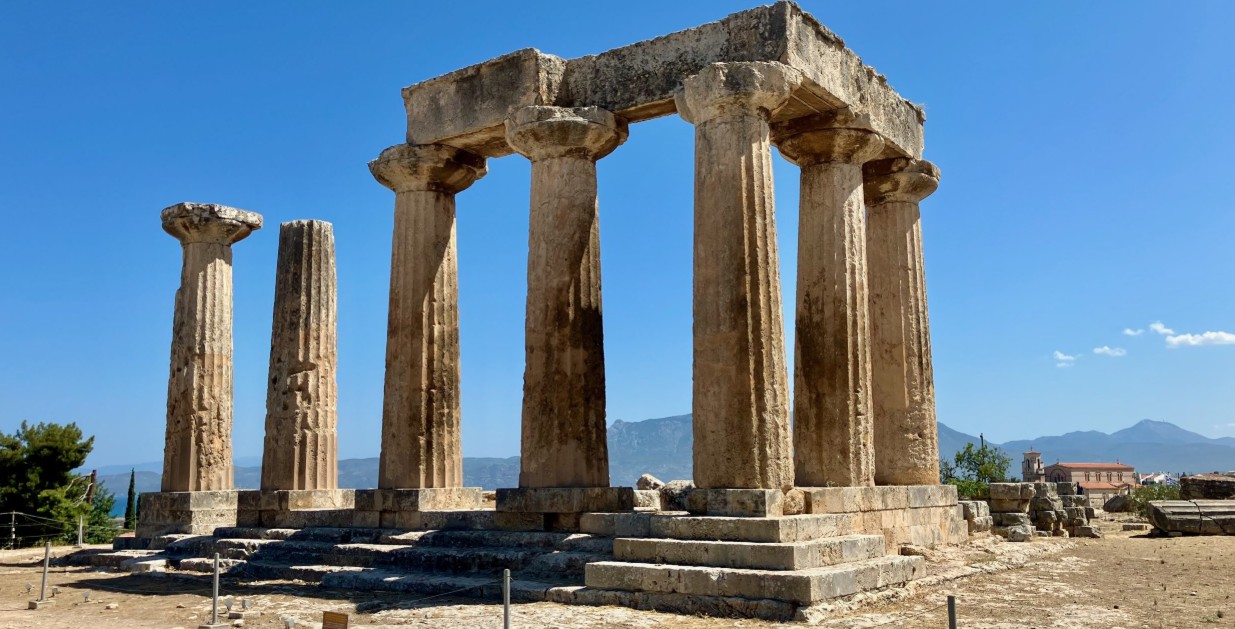
* Ancient Corinth, North ruins. The Temple of Apollo, restored by the Romans in 44 BC. Picture taken by "Forget the Channel".
>1. What life principle is most important? (1-3)
* 1 Corinthians 8:1-3 "Now about food sacrificed to idols: We know that we all possess knowledge. Knowledge puffs up, but love builds up. The man who thinks he knows something does not yet know as he ought to know. But the man who loves God is known by God."
*
Chapter 8 Overview.
The Greek and Roman cultures were full of idols and temples where people would offer sacrifices, including meat. People would buy and eat this meat at the temples.
Paul answered a question about this. The Corinthian congregation asking if it was ok to eat this meat since the idols weren't really gods. He said sure as long as it doesn't cause someone with a weak conscience to sin.
According to Paul, some have a weak conscience and others a strong one. How weak or how strong depends on how I continually act with the revealed knowledge of God; his character, his will, his design, his Word, his Son, and his Spirit. (Romans 1:21-25, Ephesians 4:17-19, 1 Timathy 4:2-5) Paul said even Christians can have a weak conscience if their understanding is incorrect.
As I grow in Christ and do the right things my conscience becomes stronger. Truly I have grown a lot and needed to change my thoughts and actions through the years. Growing in conscience isn't easy for my sinful nature is always there. God writes his word on my heart through the Holy Spirit, help to my conscience. (Romans 7:15-22)
God did not create man with a conscience. Adam and Eve knew God. Since they had not sinned they did not need to determine if what they were doing had been right or wrong. Yet God told Adam, "You must not eat from the tree of the knowledge of good and evil." When he and his wife ate from the forbidden tree they gained a conscience and passed it down to all. They learned good and evil. They gained a conscience.
Love for others is more important than my rights. God has taught me a lot from years of studying the Bible, prayer, living by faith, and his insights. I see others have a wrong understanding and thus have a weak consciousness. I should not cause them to stumble with my rights.
Listen to the above comments on 1 Corinthians Chapter 8 Overview.
* "Now about food sacrificed to idols" -The next subject the Corinthian congregation asked Paul concerns "food sacrificed to idols". Before Paul gives his direction and explanation for the direction regarding food sacrificed to idols, he makes a statement in verses 1 through 3 that can apply to more than the subject addressed here. This statment can be considered the main point of chapter 8. Paul states that loving others has priority over exersizing rights and priveledges under and because of Christ.
* Food sacrificed to idols will be addressed again in chapter 10. Comments not addressed here may be addressed in the next study commentary.
* "We know that we all possess knowledge." -Paul does not condemn knowledge. God does not condemn knowledge. Proverbs starts out by saying the books purpose is to give knowledge and wisdom (Proverbs 1:4). "The fear of the Lord is the beginning of knowledge, but fools despise wisdom and instruction." (Proverbs 1:7) And, "How long will mockers delight in mockery and fools hate knowledge? ...they hated knowledge and did not choose to fear the Lord." (Proverbs 1:22, 29) "For wisdom will enter your heart, and knowledge will be pleasant to your soul." (Proverbs 2:10)
* "Knowledge puffs up, but love builds up." -Knowledge can fill one with false pride. Consider a person standing proud with shoulders high and chest pushed forward. Love building up is explained in verses 7-13. The Christian should love his brother and sister who doubts.
* "The man who thinks he knows something does not yet know as he ought to know." -The wisest and most knowledgeable Christian realizes that his knowlege is limited. God is the only one who knows all (Romans 11:33-36)
* "But the man who loves God is known by God." -A person who tempers his knowledge with love toward God shows that he is really known and thus accepted by God as one of God's own redeemed. (Galatians 4:8-9; 1 John 4:7-8) (NIV Study Bible)
* Love and Knowledge.
Imagine being told of and then given a small deposit of gold with a map to a sure vast treasure. The map consists of learning truths and discovering that things you thought were true are misconceptions and lies that, if held onto, will keep you from the great vast treasure.
Quickly, you obtain knowledge and you begin feeling good about yourself. You begin to look at others and think, "If you only knew the lies you live. If you knew the truth, it would set you on the path to the vast treasure I am seeking. The knowledge I now possess has made me greater than you." Such was the mentality of some in the Corinthian congregation.
Paul shared with them the rich gospel truth and the hope of eternal life with God and his Son, Christ Jesus, a few years earlier. God sent them the Holy Spirit as a down deposit. The Spirit revealed to them truths through the apostles Paul, Apollos, and perhaps others.
The knowledge the congregation obtained puffed them up. They did not build others up in love. Because they did not practice love, they did not know what they ought to know. They did not love their fellow believer.
Jesus said if we love his little ones, we love him. Since those puffed up by knowledge did not practice love for neighbor, they did not love God. Did God know them?
Listen to the above comments on 1 Corinthians 8:1-3.
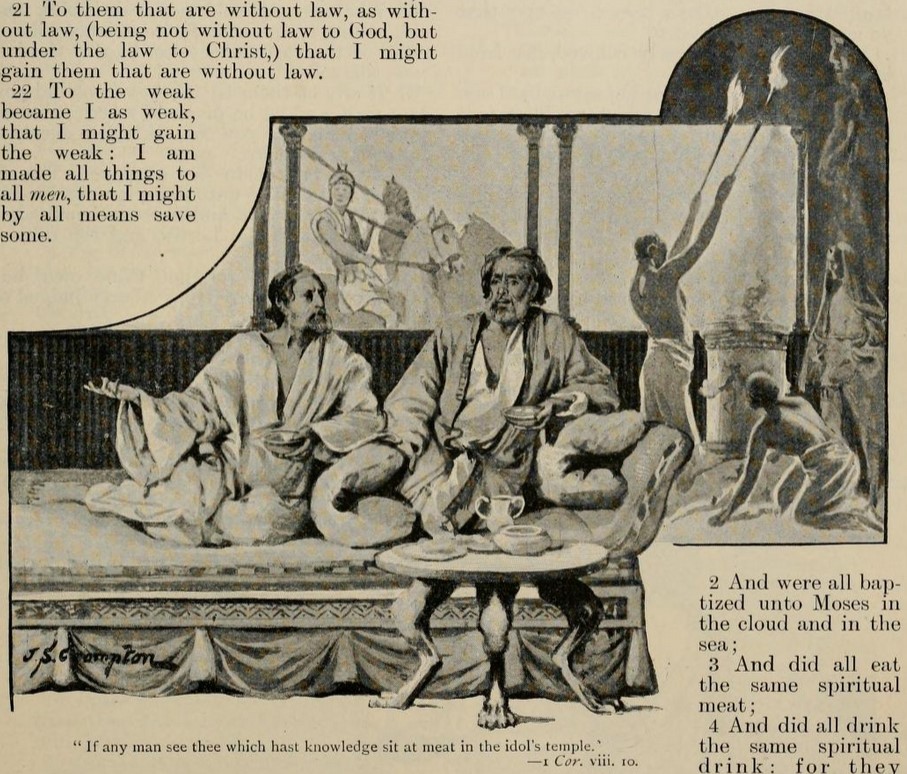
* The artwork is from the Art Bible, The Holy Bible, Illustrated. Comprising the Authorized Version of the Old and New Testaments. Embellished with 852 Illustrations. London Art Edition, Published by New York: The Christian Herald, 1897.
>What are idols and why were/are they built? (4-5)
* 1 Corinthians 8:4-5 "So then, about eating food sacrificed to idols: We know that an idol is nothing at all in the world and that there is no God but one. For even if there are so-called gods, whether in heaven or on earth (as indeed there are many "gods" and many "lords"),"
* "So then" -After making a general statement in verses 1 through 3, Paul goes back to their questions.
* Apostle Paul in verses 4b-6 repeats what they are saying and perhaps adding his input. Verse 6 is probably lyrics to a rather good song they sung, as the HCSB and GW renders with poetic typeset, and the other English translations has the poetic lines separated by commas.
* "idols" -Physical or material image or form representing a reality or being considered divine and thus an object of worship. In the Bible various terms are used to refer to idols or idolatry: "image", either graven (carved) or cast, "statue," "abomination." Both Testaments condemn idols, but with idols the Old Testament expresses more concern than the New, probably reflecting the fact that the threat of idolatry was more pronounced for the people of the Old Testament. (Holman Bible Dictionary)
An image or anything used as an object of worship in place of the true God. Among the earliest objects of worship, regarded as symbols of deity, were the meteoric stones, which the ancients believed to have been images of the Gods sent down from heaven. From these they transferred their regard to rough unhewn blocks, to stone columns or pillars of wood, in which the divinity worshiped was supposed to dwell, and which were connected, like the sacred stone at Delphi, by being anointed with oil and crowned with wool on solemn days. Of the forms assumed by the idolatrous images we have not many traces in the Bible. Dagon, the fish-god of the Philistines, was a human figure terminating in a fish; and that the Syrian deities were represented in later times in a symbolical human shape we know for certainty. When the process of adorning the image was completed, it was placed in a temple or shrine appointed for it. (Smith's Bible Dictionary: Comprising Antiquities, Biography, Geography, Natural History, Archaeology and Literature)
* "about food sacrificed to idols ...about eating food sacrificed to idols" -A cause of controversy in the early church centering on what Christians were permitted to eat.
"Food offered to idols" (HCSB) is a translation of a single Greek word, "eidolothytos" (a transliteration) which has also been rendered "things offered unto idols" (KJV) and "meat sacrificed to idols" (NIV). The identification of the object of the offering by the term "idol" suggests that it was a name which originated outside first-century paganism. It reflects the perspective and conclusion of someone who spoke as a Jew or Christian. The Greek-speaking pagans of the New Testament era would be more likely to use terms that would mean "food (things) offered to a deity or divinity." Compare 1 Corinthians 10:28 where Paul used one of these terms as an example of a possible comment by a non-Christian to a Christian, "This has been offered in sacrifice." (NIV)
Pagan sacrifices could be thought of as typically consisting of three portions. One small part would be used in the sacrificial ritual. A larger portion would be reserved for the use of the priests or other temple personnel. The largest part would be retained by the worshiper to be used in one of two ways. The one who offered the sacrifice sometimes used the remaining portion as the main course in a meal which might be served at or near the pagan temple. It is this type of religio-social event that stands behind the question raised by the letter (1 Cor. 7:1; 8:1) from the church at Corinth to Paul and consequently as the background for Paul's response in 1 Corinthians 8. The second method of disposing of the worshiper's portion would be to offer it for sale at the local marketplace. Meat that was sold in this fashion would be bought and then served as a part of a regular family meal. This situation is reflected in Paul's comments in 1 Cor. 10:23-11:1.
"Food offered to idols" is specifically mentioned in three New Testament writings, although the issue is suggested by a variety of texts. In canonical order, the first examples are to be found in the Book of Acts. The initial one comes at the conclusion of the Jerusalem conference. According to Acts 15 the success of Paul and Barnabas in evangelizing Gentiles led to a debate about the place of circumcision among Christians. At the end of the debate the acceptance of Gentile Christians by Jewish Christians was supported by a letter from the Jerusalem church which listed "what has been sacrificed to idols" as one thing from which it was expected that even Gentile Christians would abstain (Acts 15:29). This issue is referred to in Acts 15:20, even though the exact term is not used. The very expression ("what has been offered to idols") occurs also at Acts 21:25 in an apparent reference to the letter given in Acts 15. This may be one factor that led some Christians to become vegetarians. Compare Romans 14:1-21.
The term "food offered to idols" also appears in 1 Corinthians 8:1,4,7,10 and 10:19 (some manuscripts include it in 10:28). At Corinth, Paul had plunged into the pagan world in an attempt to bring them the message of Christ. Probably most of his converts were acquainted with the practice of using the leftover portions of a sacrifice for sale or celebration. It is not difficult to imagine a problem emerging as to whether a Christian was doing wrong by the public or private use of food that had been devoted to a pagan deity.
The final occurrences of this term are in Revelation 2:14,20, where in addition to the eating of food offered to idols two of the seven churches are scolded for idolatry and moral failure. It is significant that these problems are regularly connected in the New Testament. (Robert Byrd, Holman Bible Dictionary)
* "We know that an idol is nothing at all in the world" -An idol represents no real god and possesses no power (Deuteronomy 6:4; Psalm 115:4-7, 135:15-17; Isaiah 44:12-20). But there are demons behind them (10:20).
* "that there is no God but one." -Repeated many times in the Bible. (2 Samuel 7:22; 1 Chronicles 17:20; John 1:18
* "For even if there are so-called gods, whether in heaven or on earth" -The alleged gods of Greek and Roman mythology many "gods" and many "lords." Not that there actually are many gods and lords. This would contradict the consistent and emphatic teaching of Scripture that there is but one God. Paul is recognizing that obvious fact that there are many who are worshiped as gods - though they do not actually exist, to say nothing of being deities. (NIV Study Bible)
* "as indeed there are many 'gods' and many 'lords'" -Worshiped by such by many, but not actually diety. See note above.
>What is true about God the Father and the Lord Jesus Christ? (6)
* 1 Corinthians 8:6 "yet for us there is but one God, the Father, from whom all things came and for whom we live; and there is but one Lord, Jesus Christ, through whom all things came and through whom we live."
* As stated in the comments to the question above, this is a line of a song they sung.
* "yet for us there is but one God, the Father" -There is but one who is truly and essentially God, (though indeed there be more than one person in the Deity), the Father, who is the Fountain of the Deity, communicating his Divine nature to the other two persons, and of whom are all things. It is a term which significant the primary Cause and Author of all things: we subsist in him, according to that of the apostle, Ac 17:28: In him we live, and move, and have our being; and we are for him, created for his honor and glory, as the phrase may also be translated. (Matthew Poole's Commentary on the Holy Bible)
* "from whom all things came and for whom we live" -The Creator God. The Trinity was involved in creation. (John 1:1-3)
* "and there is but one Lord, Jesus Christ," -He is the second person in the holy Trinity. It is the observation of a learned author: That though the name of God be often given to Christ, yet no where by Paul where he make mention of God the Father; from whence he concludes, that the term of Lord given to Christ, significant his pre-eminence above all things, (the Father excepted), according to what the apostle speaks, 1Co 15:27. By this Christ, saith the apostle, are all things: All things were made by him, and without him was not any thing made that was made, John 1:3; yet the difference of the phrase is observable, to denote to us the order of working in the holy Trinity. All things are of the Father by the Son. (Matthew Poole's Commentary on the Holy Bible)
* "through whom all things came and through whom we live." -Jesus is the Word spoken during creation. (John 1:1:3)
* One God. One Lord.
What is an idol? A man-made idea that may be a form put before God, considering Exodus 20:3-5 and Deuteronomy 5:7-9: "You shall have no other gods before me." Jesus further defines an idol with these words, "No one can serve two masters. Either he will hate the one and love the other, or he will be devoted to the one and despise the other." (Matthew 6:24; Luke 16:13). "If you love me, you will obey what I command." (John 14:15)
What did Jesus command us? Apostle Paul repeats what Jesus told his apostles on the night that he was betrayed, "A new command I give you: Love one another. As I have loved you, so you must love one another. By this all men will know that you are my disciples, if you love one another." (John 13:34-35)
Our problem is that we do not. Why? Because we have set up idols in our hearts. We have placed ourselves before others. We do not love as Jesus commanded us. We have sinned, sinned, sinned. Oh, what a sinful race we are! What good is it to know there is one God and one Lord and we do not obey them? Yesterday I was too sick to write BDBD. I wonder if anyone assumed something was wrong and prayed for me.
Listen to the above comments on 1 Corinthians 8:4-6.
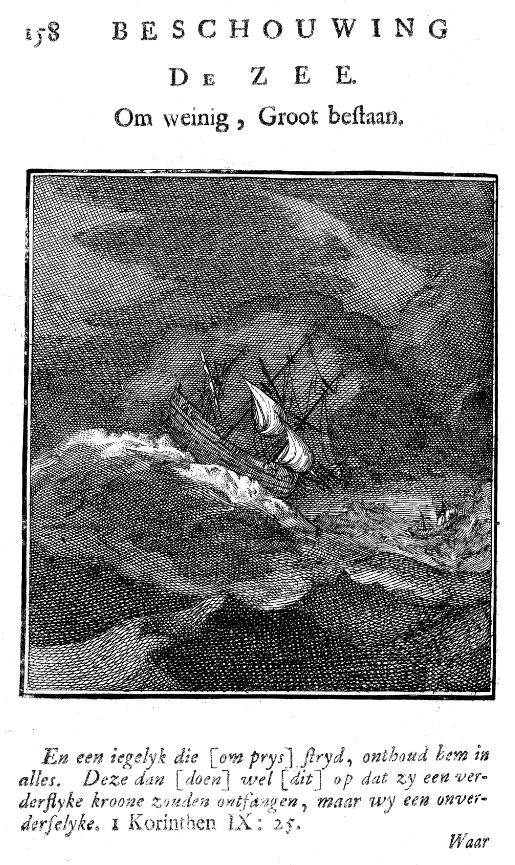
* The artwork "The Sea: For Little, Great Existence" is from a book by Luiken, Jan (1649-1712) titled "Beschouwing der wereld : bestaande in hondert konstige figuuren, met godlyke spreuken en stichtelyke verzen / door Jan Luiken", now in public domain.
Under a dark sky, two sailing ships are tossed at sea by enormous waves. The Dutch artist and poet Jan Luiken (1649-1712) was responsible for drawing this emblem and composed the poem that accompanies it. The etching was executed by Jan Luiken or his son Casper Luiken (1672-1708), who had used this image in an earlier work. The poem is to long to include here. The attendant scripture text is 1 Corinthians 9:25.
Courtesy of the Digital Image Archive, Pitts Theology Library, Candler School of Theology, Emory University.
>2. What is the conscience and how had some Christians defiled it? (8)
* 1 Corinthians 8:7 "But not everyone knows this. Some people are still so accustomed to idols that when they eat such food they think of it as having been sacrificed to an idol, and since their conscience is weak, it is defiled."
* "But not everyone knows this." -Meaning more that they have not truly accepted that an idol is nothing more than stone and wood, not a real personality in their heart, more than actually physically hearing it with their years. "Everyone" here is a brother and/or sister in Christ and/or on the verge of becoming a believer in Jesus as the rest of the passage indicates.
* "still so accustomed to idols" -Idols are part of their society, family history, personal upbringing, and education and personal practice. Pagan worship was an interwoven part of their lifestyle and practice no matter how much they believed in it or not.
* "when they eat such food they think of it as having been sacrificed to an idol" -Sacrificed here is an act of offering something, in this case meat, to a deity in propitiation or homage, especially the ritual slaughter of an animal or a person, rare as it was in Greek and Roman pagan worship.
* "since their conscience is weak"
* "it is defiled."
>Does that mean their relationship with God has changed? (8)
* 1 Corinthians 8:8 "But food does not bring us near to God; we are no worse if we do not eat, and no better if we do."
* "But food does not bring us near to God"
* "we are no worse if we do not eat"
* "no better if we do.""
>How does the life principle in verses 1-3 dictate the actions described in verses 9-13?
* 1 Corinthians 8:9-12 "Be careful, however, that the exercise of your freedom does not become a stumbling block to the weak. For if anyone with a weak conscience sees you who have this knowledge eating in an idol's temple, won't he be emboldened to eat what has been sacrificed to idols? So this weak brother, for whom Christ died, is destroyed by your knowledge. When you sin against your brothers in this way and wound their weak conscience, you sin against Christ. Therefore, if what I eat causes my brother to fall into sin, I will never eat meat again, so that I will not cause him to fall."
* "the exercise of your freedom"
* "a stumbling block to the weak"
* "this weak brother, for whom Christ died, is destroyed by your knowledge"
* "I will never eat meat again" -
* Why? Love is the Reason.
The council in Jerusalem in ~49 A.D. made the most controversial decisions of their time regarding Gentiles coming to believe in Jesus. Should they follow the Laws of the Old Covenant given through Moses? (Acts 15:1-5) First, Apostle Peter reminded the council of the most important truth: through the grace of our Lord Jesus, we are saved, including the Gentiles. He asked them, "Why do you try to test God by putting on the necks of the disciples that yoke.?" (Acts 15:6-11)
James, the brother of Jesus, agreed, adding that they should not make it difficult for the Gentiles who are turning to God (Acts 15:19). The council, with careful words, wrote, "It seemed good to the Holy Spirit and to us not to burden you with anything beyond the following requirements: You are to abstain from food sacrificed to idols, from blood, from the meat of strangled animals, and from sexual immorality. You will do well to avoid these things. Farewell." (Acts 15:28-29, reference vs. 20) No explanation is given. Simply, "abstain from these things."
Approximately 11 years later, 6 years after Paul writes these letters to the Corinthians, the council's letter with the instruction "abstain from food sacrificed to idols" is remembered by the Jerusalem elders. (Acts 21:25) Again, no explanation is given. Two churches are rebuked in Revelation 2:14 and 2:20 for "eating food sacrificed to idols and by committing sexual immorality". The reason to abstain is not given there either.
However, 1 Corinthians, written in 55-56 A.D., supplies us with reasons. "Therefore, if what I eat causes my brother to fall into sin, I will never eat meat again, so that I will not cause him to fall." (13) Also, "Do I mean then that a sacrifice offered to an idol is anything, or that an idol is anything? No, but the sacrifices of pagans are offered to demons, not to God, and I do not want you to be participants with demons." (1 Corinthians 10:19-20) More on that later.
Today, food sacrificed to idols is not an issue within congregations and amongst denominations. However, many exist that are just as contentious. Some denominations claim that others are from the devil because they do not do this and they do that evil thing. Why do you try to test God? Who appointed you head of Christ's church? When did Jesus give you the keys? Does the exercise of your religious practices become a stumbling block to the weak, for whom Christ died? If you are such a superior, enlightened Christian, why not bring your teachings to those wandering the streets at night and invite them to eat with you, rather than condemning someone who calls on the name of Jesus and wound their weak conscience?
Listen to the above comments on 1 Corinthians 8:7-12.
II. The Rights of an Apostle (9:1-18)
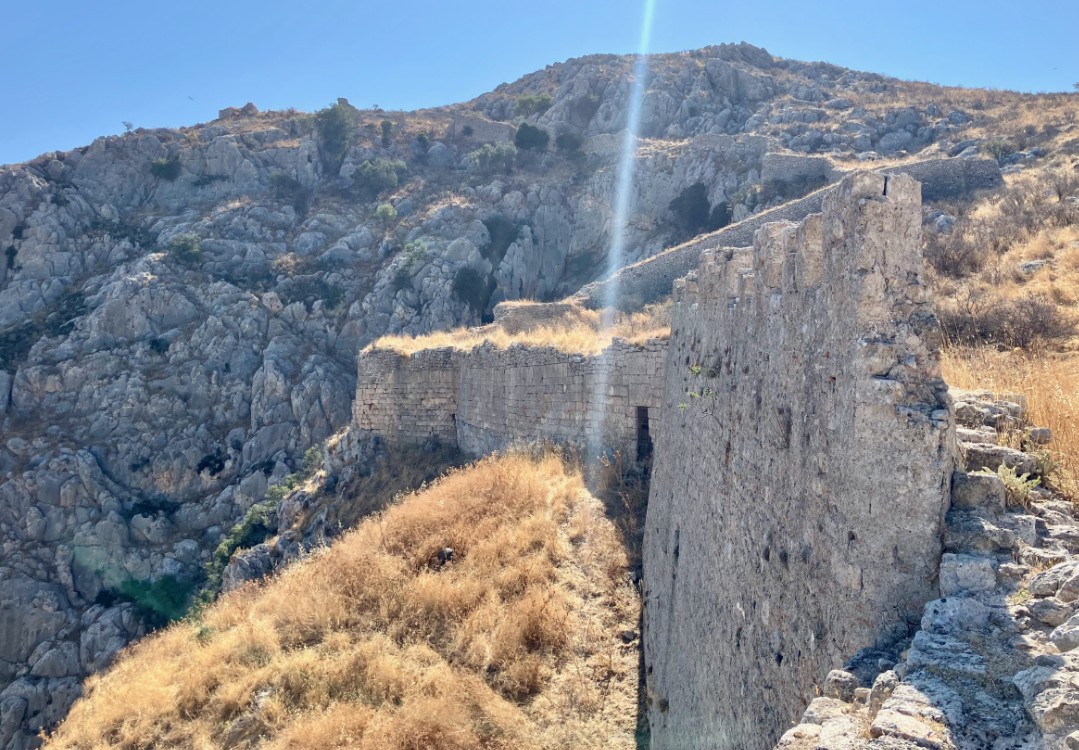
* In the Acrocorinth, the hill fortress above Corinth, stood the world-renowned Temple of Aphrodite, goddess of love, the site of worship and celebration of sexual excess. Nothing much remains of the temple now, but below is a photo of the hill it stood on. Picture taken by "Forget the Channel".
>3. Who is Paul? (1-2)
* 1 Corinthians 9:1-2 "Am I not free? Am I not an apostle? Have I not seen Jesus our Lord? Are you not the result of my work in the Lord? Even though I may not be an apostle to others, surely I am to you! For you are the seal of my apostleship in the Lord."
*
Chapter 9 Overview.
Apostle Paul is continuing his thoughts from the previous chapter. There he wrote that although we are free to eat meat offered to idols because they are not alive and not gods, we shouldn't do it if it would cause a fellow believer who has a weak conscience to sin.
Continuing the thought of freedom and rights in Christ he reflects on his own life actions. Most of the apostles and pastors had a wife that they brought with them as they traveled from congregation to congregation. People who serve the church don't need to be single.
Most apostles and pastors received some of the offerings to support themselves, their wives, and their families. People who serve the church don't need to have an income outside the congregation to support themselves.
Paul did not exercise these two rights because he knew that if he remained single and if he earned his own income it would be better for the congregations and the spread of the gospel. He was telling them these things as an example to them and me. It is more blessed to give than to receive. (Acts 20:35)
Paul's also stated that self-sacrifice does not go without rewards (17, 24-27). Jesus will pass out rewards when he comes again. He expects a return on his investment.
Have I sacrificed for those I love? Have I refused my rights and freedom for the sake of others? Every day I have choices.
Listen to the above comments on 1 Corinthians Chapter 9 Overview.
* Apostle Paul is continuing and expanding on the point he made in the previous chapter 8 by using himself as an example. The point there was that though they have rights and freedoms in Christ they should not exercise those rights if they might cause a fellow believer, one with a weak conscience, to sin. Paul is saying that they should circumcise their freedom.
* "Am I not free? -Paul is adding to the point he is about to make.
* "Am I not an apostle?" -The be an apostle one must have been personally called and sent by Jesus, the general meaning of the word is sent. Jesus is called an apostle in this general meaning in Hebrews 3:1 and by Jesus, himself in John 20:21 because the Father sent him.
Apostle Paul states he is an apostle here because he wants to add to the point that he has freedoms and right as an apostle, but does not use them.
* "Have I not seen Jesus our Lord?" -Paul, when converted saw a bright light and heard Jesus. He was blinded it was so bright. That was Jesus. (Acts 9:1-9; 22:6-16; 26:12-18) Then, shortly after his conversion went into the desert and was taught by Jesus through the Spirit. (Galatians 1:17)
* "Even though I may not be an apostle to others, surely I am to you!" -Paul founded the church in Corinth.
* "For you are the seal of my apostleship in the Lord." -A seal was used in ancient times to mark something, sometimes as ownership, other times to prove that they were the ones who sealed what was inside the envelope or sack. When Jesus was placed in a tomb, Pilate placed his seal on it, not because he owned the tomb, but to show that he indeed stated that Jesus' tomb should not be opened for punishment of death. A sack of clothing, wool, tomb, or other artifacts were closed. The seal was placed over the closed opening and could not be opened without the owner of the seal's approval. The seal showed who owned the rights. Paul was not saying he owned the congregation, but rather he was used to gather them for Christ by sharing the gospel of Jesus Christ. He will present them to his Lord on the day of accounting at the resurrection. More on this in chapter 15.
>What rights did he have and yet did not exercise? (3-6)
* 1 Corinthians 9:3-6 "This is my defense to those who sit in judgment on me. Don't we have the right to food and drink? Don't we have the right to take a believing wife along with us, as do the other apostles and the Lord's brothers and Cephas? Or is it only I and Barnabas who must work for a living?"
* "This is my defense to those who sit in judgment on me." -Paul mentions in other letters that people have made judgments about him. Many stated that he is "lesser" than others. Some say he is not an apostle. Paul says the fact that there is a congregation in Corinth that profess the name of Jesus as their Lord and Savior is proof of his apostleship.
* "Don't we have the right to food and drink?" -An interesting way to say, "To received a stipen from the congregation so that he can buy drink and food to survive as he does the Lord's work. The Jewish synagogue system worked on this principle since after the return of the exile in Babylon. Even the Levitical system set down in the Mosaic Law established that the Levites who serve the Lord God in the temple worship were to receive a part of the offering.
* "Cephas" -Cephas is the transliterated Aramaic word "Kepha" (meaning rock/stone) given to the Apostle Peter by Jesus, representing the same name as the Greek Petros (Peter). The common Jews spoke Aramaic, not Hebrew and not Greek. While the New Testament was written in Greek, Paul often used the Aramaic form Cephas most likely because that is what he was called instead of what we now use, Peter.
* "Barnabas" -Barnabas originally meet Paul while in Antioch. Barnabas was a believer before Paul. He was one of the first to accept Paul's conversion and became at first Paul's defender and promoter, then co-missionary, friend, missionary, and once found himself on the opposite side of an argument with Paul. Yet, they always remained respectful friends. Paul reveals that Barnabus was also a self supporting missionary and pastor.
* Lifestyles
Jesus personally chose and trained many apostles according to his divine purpose for them. Each had a different personality. Each had their own look and skill. Each had been given a different path as they fulfilled his command, "Be my witnesses throughout the whole world." (Matthew 10:18; Mark 13:9; Luke 21:13, 24:48; Acts 1:8, 9:15, 13:46) Each made lifestyle choices as they glorified Jesus in obedience and submission and enjoyed his presence forever.
Apostle Paul, as he continued teaching the Corinthian believers the virtue of self-sacrifice, reveals the contrast between his lifestyle choices and those of the other apostles. Paul had told them that all the apostles were on display at the end of the procession, like men condemned to die in the arena, a spectacle to the whole universe, to angels as well as to men. (4:9) That the apostles shared by common choice. But not every choice was common.
Paul chose to remain single, while other apostles married (5). Paul chose to be self-sufficient, holding a tent making job, while the other apostles received a stipend from the church (4, 6). Both choices were right, good, and a blessing based on the individual's circumstances, as Apostle Paul had revealed in previous chapters.
The important consideration is motive. What motivates me when I decide? Paul was free, an apostle, seen the Lord, and his ministry produced true spiritual fruit, the Corinthian church (1-2). Yet he used none of those for self-gratification. His motive was to please his Lord. (7:32)
Listen to the above comments on 1 Corinthians 9:1-6.
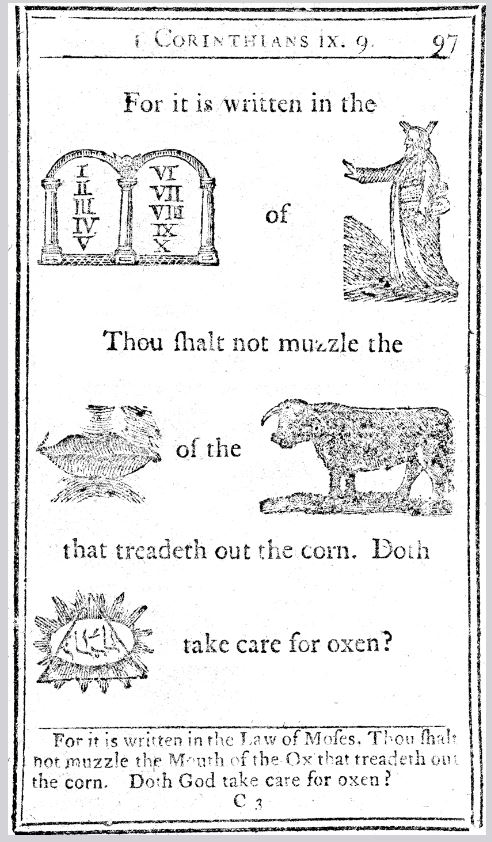
* The artwork "Apostles" is from a children's English Bible Selections, 1796 titled "A new hieroglyphical Bible for the amusement & instruction of children : being a selection of the most useful lessons, and most interesting narratives, (scripturally arranged) from Genesis to the Revelations : embellished with familiar figures & striking emblems elegantly engraved : to the whole is added a sketch of the life of our Blessed Savior, the holy Apostles, &c. : recommended by the Revd. Rowland Hill ...", now in public domain.
Each page has illustrations to replace major topical items in the passage. In this case illustrating 1 Corinthians 9:9 using images for the ten commandments, lips, a bull, and Moses, theissues of Apostleship.
Courtesy of the Digital Image Archive, Pitts Theology Library, Candler School of Theology, Emory University.
>What principle is defined in verses 7-10?
* 1 Corinthians 9:7-10 "Who serves as a soldier at his own expense? Who plants a vineyard and does not eat of its grapes? Who tends a flock and does not drink of the milk? Do I say this merely from a human point of view? Doesn't the Law say the same thing? For it is written in the Law of Moses: "Do not muzzle an ox while it is treading out the grain." Is it about oxen that God is concerned? Surely he says this for us, doesn't he? Yes, this was written for us, because when the plowman plows and the thresher threshes, they ought to do so in the hope of sharing in the harvest."
* "Who serves as a soldier at his own expense?" -All soldiers are feed by the one, group, or country they serve.
* "Who plants a vineyard and does not eat of its grapes?" -The worker is given their wages by the owner of the vines. In ancient times that would have been someof the harvest.
* "Who tends a flock and does not drink of the milk?" -The shepherds are allowed to drink the milk.
* "they ought to do so in the hope of sharing in the harvest." -And so a principle is laid down. The apostles who receive a stipend are allowed to do so as long as they are serving the ones who are supplying the stipend. If they are lazy, they should not receive the pay.
>Why didn't Paul exercise these right? (11-12, 15)
* 1 Corinthians 9:11-12 "If we have sown spiritual seed among you, is it too much if we reap a material harvest from you? If others have this right of support from you, shouldn't we have it all the more? But we did not use this right. On the contrary, we put up with anything rather than hinder the gospel of Christ."
* 1 Corinthians 9:15 "But I have not used any of these rights. And I am not writing this in the hope that you will do such things for me. I would rather die than have anyone deprive me of this boast."
* "we put up with anything rather than hinder the gospel of Christ" -They were new converts. Asking for support may have chased them away and/or given a wrong impression. By deciding not to receive the money, and possible suffer because of it, Paul gave no reason for the new converts to leave.
* Most modern people who serve in the church expect to receive a stipend, a salary. If they do not receive a salary, then they will not serve. Some will even stop attending the congregation, and others not attend any congregation. Because they receive a degree, or write a book, or are a good musician they will not give freely. They expect to be paid.
I am often sadden to see Christian web sites that sell Bible commentary and Bibles and translations, collect information and sell it, and/or have lots of adds to make money. The same is for music. Sometimes they did not even create the material. Christianity for profit. So is these materials only for the rich? Are nations and social groups who do not have money excluded? What happened to the missionary that went to other nations and social groups at their own expense? Did not Christ pay the price so we could receive the gift of the Holy Spirit and the gospel? So I am sad to see modern Christians seek to make Christianity like the money tables and the sell of animals in the temple.
* Matthew 10:8b, Jesus said, "Freely you have received; freely give."
>4. What does "receive their living" mean? (13-14)
* 1 Corinthians 9:13-14 "Don't you know that those who work in the temple get their food from the temple, and those who serve at the altar share in what is offered on the altar? In the same way, the Lord has commanded that those who preach the gospel should receive their living from the gospel."
* "receive their living" -The church followed the principal established in Jewish synagogues. If there were ten men in a town or village, they would tithe to support a paid full time attendant. The book of Acts of the Apostles and the four gospels mention these men. That person then received the mean of the ten paying the stipend. He was not the richest, nor the poorest.
>Does this included getting rich from the gospel?
* 1 Corinthians 9:15 "But I have not used any of these rights. And I am not writing this in the hope that you will do such things for me. I would rather die than have anyone deprive me of this boast."
* No. Never get rich. If the number of men increased beyond ten, the wages of the attendant would increase, but so would his responsibilities. So when there were more than twenty, another person was hired to assist his labor. Eventually they would move out of the place they meet for Sabbath, either renting a hall or building a synagogue from the extra money collected. But no one was ever meant to get rich. Terrible that happened amonst the Jews and in the first church. But none of the apostles were rich.
* We Put Up With Anything.
The point is stated again and again using many examples. Paul could have received a salary, but voluntarily chose not to receive any money for his labors for the Lord and his church. Apostle Paul even finds the obscure Deuteronomy 25:4 to practically beat his point into the Corinthian believers' and my skulls.
He declares, "We put up with anything rather than hinder the gospel of Christ" (12). Anything! Do not let anything get the better of me as I serve the Lord and his gospel. Do not let anything overwhelm me as I sacrifice for Jesus and his church.
Do not let something or someone's attitude tie me to the bed with an imaginary rope as I serve the church of Christ. Do not let depressing thoughts hinder the gospel of Christ, as I serve as a layman, for Paul was a layman apostle. Though many tried to get the better of him, overwhelm him, tie him up, beat him down, and hinder his layman work, Apostle Paul put up with it and moved on.
Stay calm and move on. Be in Jesus' peace. Put up with anything, even a silly continuing computer rejecting keyboards. Be in Jesus' peace. Find it. Accept it. Hold onto Jesus in thought, heart, and action. Be one with Christ Jesus, the Prince of Peace who put up with everything, including me in love.
Listen to the above comments on 1 Corinthians 9:7-14.
>What example can we follow in preaching the gospel? (16-18)
* 1 Corinthians 9:16-18 "Yet when I preach the gospel, I cannot boast, for I am compelled to preach. Woe to me if I do not preach the gospel! If I preach voluntarily, I have a reward; if not voluntarily, I am simply discharging the trust committed to me. What then is my reward? Just this: that in preaching the gospel I may offer it free of charge, and so not make use of my rights in preaching it."
* "Yet when I preach the gospel... I am compelled to preach"
* "If I preach voluntarily, I have a reward" -Jesus' gave several parables that lays this principle down.
* "if not voluntarily, I am simply discharging the trust committed to me." -Jesus' gave several parables that also lays this principle down.
* "in preaching the gospel I may offer it free of charge" -This is the principle that I follow with FreeBibleStudyHelp.com from the very beginning. No charge, No adds, No registration. No subscription. I received freely, I give freely. "Write for One. Read my many."
* "so not make use of my rights in preaching it." -This is the exaple Paul wants the congregations to follow.
* Compelled to Preach.
"Woe to me if I do not preach the gospel!" Apostle Paul wrote (16b). A woe is no light statement, for it is deep distress, misery, and calamity. Apostle Paul was compelled to preach the gospel (16a). He is a classic description of prophetic reluctance overcome by divine compulsion to preach Jesus, just as the prophet Jeremiah was when he said, "If I say, 'I will not mention him or speak any more in his name,' his word is in my heart like a fire, a fire shut up in my bones. I am weary of holding it in; indeed, I cannot." (Jeremiah 20:9)
Apostles Peter and John, when they were before the rulers, elders, and teachers of the law, who told them to stop teaching about Jesus, told them, "We cannot help speaking about what we have seen and heard." (Acts 4:5-21) And so they continued to witness about Jesus, even with more threats of punishment, even when James, John's brother, was killed.
The Lord Jesus had laid on these men the irresistible volition to preach the good news. They breathed the gospel. Paul said he could preach voluntarily or involuntarily (17). If voluntarily, he would receive a reward. If involuntarily, he would simply be discharging the trust committed to him on the road to Damascus (Acts 9:1-19, 26:16-18).
Since all are compelled to preach, that is, commanded to witness about what Jesus has done for us, then why be a reluctant witness and lose the reward? Why bury what is entrusted and not get a return, as Jesus taught in the parable? In preaching the gospel, I voluntarily offer it free of charge and do not exercise my rights. I do not quench the fire in my bones.
Listen to the above comments on 1 Corinthians 9:15-18.
>5. Why did Paul use the term 'to win the soul' instead of 'saving the soul' or 'bringing him to Christ'?
* 1 Corinthians 9:19 "Though I am free and belong to no man, I make myself a slave to everyone, to win as many as possible."
* "I make myself a slave to everyone" -Self imposed. Jesus said similar with "...the Son of Man came to serve and to give his life as a ransom for many."
>Why did he strive so much to win as many as possible?
* "to win as many as possible." -"To win" is an interesting term referring to the Roman races and Greek Olympics where the winners received prizes as can be seen in the next paragraph's allegories (24-27). Some English translations have "gain". Yet, elsewhere these English Bibles translate the same Greek word "win". Elsewhere, Paul uses such an illustration, but does not use this phrase. 1 Peter 3:1 says, "Wives, in the same way be submissive to your husbands so that, if any of them do not believe the word, they may be won over without words by the behavior of their wives..."
* Matthew 23:25 and 1 Peter 3:1 the only places outside of this chapter this term is applied to bringing someone to faith. Matthew 23:25 records Jesus saying, "You travel over land and sea to win a single convert..." 1 Peter 3:1 is in the comment above.
* Besides this chapter Paul uses the term in Ephesians 6:6. However, there it does not mean winning someone to faith in Jesus. "Obey them not only to win their favor when their eye is on you, but as slaves of Christ, doing the will of God from your heart."
>What was his method in winning as many as possible?
* Paul did not place any burden on the new converts. He spent as much time preaching and teaching. He served others. In all these things he followed Jesus' example.
>6. What would it be like to become like a Jew?
* 1 Corinthians 9:20 "To the Jews I became like a Jew, to win the Jews. To those under the law I became like one under the law (though I myself am not under the law), so as to win those under the law."
* "To the Jews I became like a Jew" -Follow the Mosaic law, the traditions of the elders, and the social expected Jewish practices.
* "To those under the law I became like one under the law" -Paul means he subjected himself to the Mosaic laws. The Mosaic laws concerned three main areas. First, it concerns the law related to worshiping God and the temple sacrificial system. Second, there are social and society laws. Third, there are person laws to follow.
* "as to win" -Again he uses this interesting word. See above.
* "though I myself am not under the law" -Paul was a Jew by birth. However, he was a Christian which had authority over him more than being a Jew. Paul goes into great detail in his letters to the Galatians and especially to the Romans on how Jesus sets us free from the law. Sadly, some congregations want to submit those who attend their services to the law again stating that other congregations that do not obey the ten commandments are going to hell.
* Acts 16:3 Paul had Timothy circumcised. Acts 21:21-26 Paul included himself in a Jewish vow ritual.
>What inner struggle did Paul have to go through to become like a Jew?
* Paul had to accept Jesus as being the final say. Jesus gave the law and fulfilled the law. This was hard for Paul to accept since the Mosaic law was so interwoven in Jewish society. Their identity lies in practicing Jewish customs and Mosaic laws.
>What would be the life style and the way of thinking of those not having the law?
* 1 Corinthians 9:21 "To those not having the law I became like one not having the law (though I am not free from God's law but am under Christ's law), so as to win those not having the law."
* "To those not having the law I became like one not having the law" -Abraham, Isaac, Jacob, Noah, and Job did not have the Mosaic Law. Neither did the church for Jesus fulfilled the law. The apostles during the concil in Jerusalem said the Gentles should not be subject to neither the Mosaic law, the Jewish customs, and not even the Abraham circumcision. The Gentile church is not bound by these. Rather, we are bound to Christ and he taught us how to live under a much higher and stricter code.
* The Gentles needed to change from pagan worship to worshiping the one true God, just as Abraham did. They needed to give up their society practices that intermingled with pagan practices. They needed to transform by the renewing of their mind. (Romans 12:2)
* The difference in meeting sytles and customs between Messianic Jews and Gentile believers (aka Christians) coninued from the start of the church through the Council at Jerusalem and the First Concil of Nicaea in 325 A.D. following the Roman legalization of Christianity. Constantine sought to resolve disputes in the Eastern church, specifically Arianism. The Nicaea Creed was the result. The Eastern Orthodox Church split from the Roman Catholic Church in the 1054 Great Schism, due to deep-seated theological, political, and cultural divisions. Key factors included disagreements over papal authority (the Pope's supremacy vs. the Patriarch's role), the filioque clause (addition to the Nicene Creed), liturgical differences (unleavened bread), and cultural, language barriers.
>How could Paul become like one not having the law?
* Paul followed the decision set down by the apostles and church elders in Jerusalem given to the Gentles rather than the Mosaic law and Jewish customers.
* The liberal minded Christian and non-Christian would say that Paul was not being true to himself. One day he is a Jew and another he is a Gentile. Such a statement is arrogant judgemental lies. Who are you to dictate what a person should be like and not be like? What does the Bible say? That is what I am. Paul was given a mission by God and to God he was true. Paul chose to do what was needed to win people to Jesus. This was his identity as a missionary, as an apostle, as a witness of Jesus. He was neither Jew nor Gentile for he learned that they are nothing. No wonder he cared not if he was judged by man. He knew it will be Jesus who judges him.
>What did he do to win the weak?
* 1 Corinthians 9:22 "To the weak I became weak, to win the weak. I have become all things to all men so that by all possible means I might save some."
* Romans 14 and 15.
* "so that by all possible means I might save some." -All translations I have has this as first person, "I might save some". Four ancient manuscripts (Vulgate, Syriac, Wiclif, Rheims) have "I might save ALL". Paul fully beieved that Jesus saves through his death and resurrection. He was saying that with witness, both verbal and non-verbal, he was the means God used to present the gospel of salvation through Jesus.
* In Antioch, after the first missionary journey by Paul and Barnabus, some strong headed Jews came from Jerusalem and tried to dictate Jewish customers and lifestyle on the Gentlies who came to believe in Jesus. In that situation the Gentiles were the "weak" ones. Paul and Barnabus came to their defense. They even went to Jerusalem to see what the other apostles and elders would say. Perhaps that would be an exaple of where Paul became "weak" to "win" the weak, or perhaps to save them from falling away from the congregation.
>Why was it absolutely necessary to win the weak?
* The weak could be Jew or Gentile. They were the ones who could be weak in conscience. They could also be ones who were the hidden or less visible parts of the body. Jesus looked after and defended the widows, ophans, prostitues, tax collectors, and "sinners". In Jewish societies they were the "weak" and the most likely to come to faith in Jesus. Jesus said, "It is not the healthy who need a doctor, but the sick."
>What was Paul's motivation?
* 1 Corinthians 9:23 "I do all this for the sake of the gospel, that I may share in its blessings."
* "I do all this for the sake of the gospel" -Flipping this, Paul is also stating that those who do not do this are not partaking in the blessing.
* "that I may share in its blessings." -"Share" is a key word here. "Blessing" is another. Previously, Paul was saying that the worker deserve his wages, while also saying he did not receive money. So, the blessing here is not money. Rather, it is fellowship in this life and a reward in the next. The Greek word for "blessing" is also translated "reward".
* Romans 11:14 and 7:16 also use the term "will save".
* Winning, Gaining, Saving.
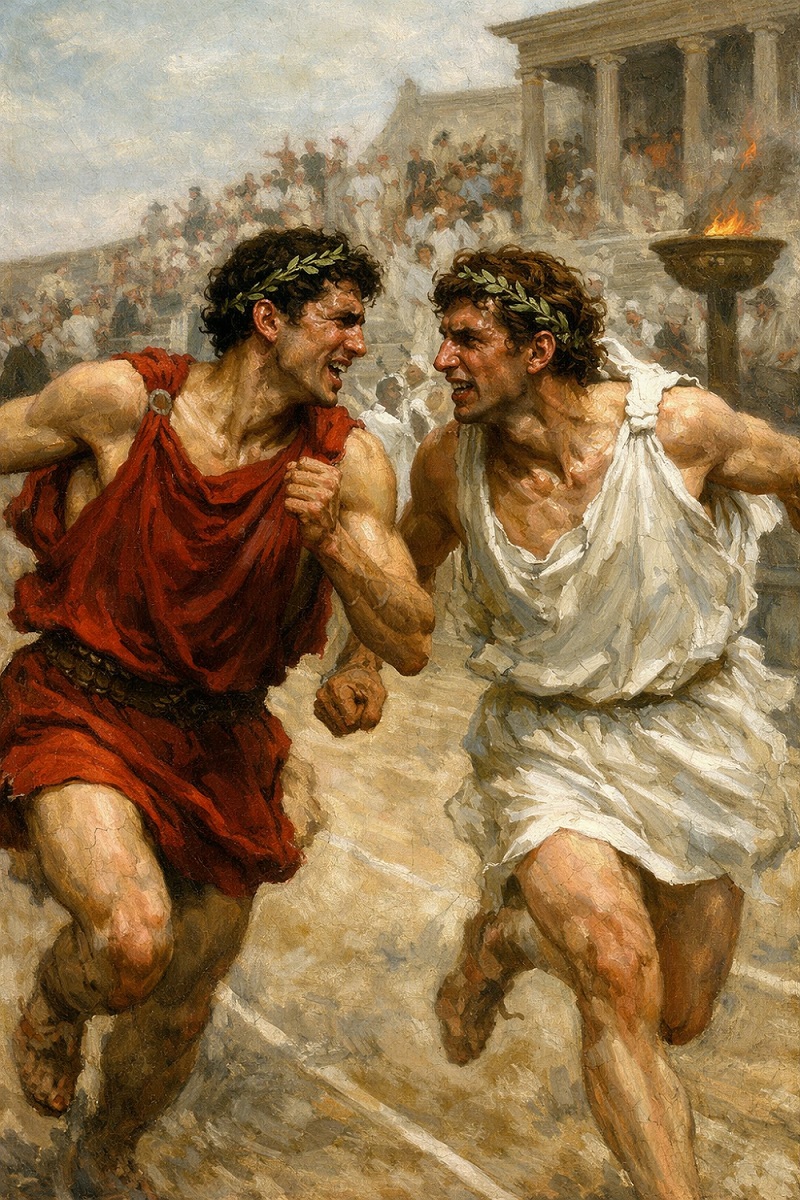
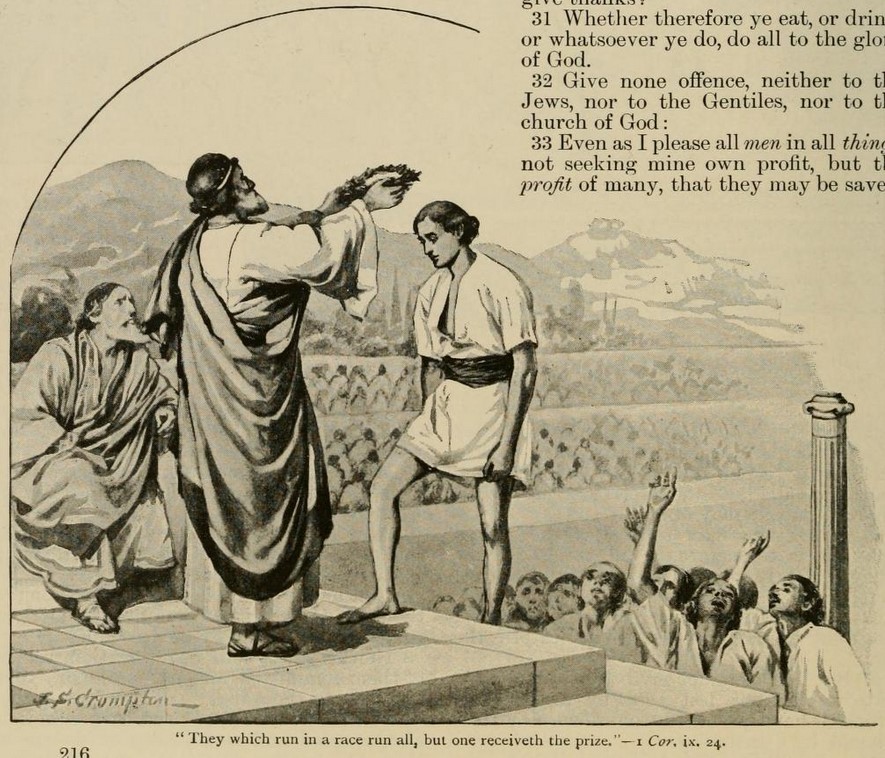
The two Greek verbs that are interchangeable and repeated in almost every sentence in this paragraph are "kerdaino" (19-22a) and "sozo" (22b) (transliterations). "Kerdaino" is translated as either "to win" or "might gain". The English translations that use "might gain" translate the verb as "to win" elsewhere. (1 Peter 3:1; Matthew 23:25) The illustration depicts winning in the Corinthian Isthmian Games, similar to the Greek Olympics. Paul expounds on this in the next paragraph.
The point is to submit to Jesus and the gospel so people may come to faith in Jesus. I am to give up personal culture, family background, personal preference, society tradition, and religious habits so that those I witness to may be open to the good news. One day, Paul played the part of a Jew. Next, he played the part of a Gentile. His mannerisms depended on who he was with, so they would identify with him and be open to what he said.
Paul is following Jesus' lead, who taught, "You know that the rulers of the Gentiles lord it over them, and their high officials exercise authority over them. Not so with you. Instead, whoever wants to become great among you must be your servant, and whoever wants to be first must be your slave-- just as the Son of Man did not come to be served, but to serve, and to give his life as a ransom for many." (Matthew 20:25-28)
Jesus, the eternal God, submitted himself, being clothed with humanity, becoming like us, so that we could identify with him, and so listen to him, and accept him as the eternal God. Jesus did this to win us to himself. What are you willing to give up to win souls?
Listen to the above comments on 1 Corinthians 9:19-23.
>7. What do the "race", "running", and "prize" refer to? (24)
* 1 Corinthians 9:24 "Do you not know that in a race all the runners run, but only one gets the prize? Run in such a way as to get the prize."
* "only one gets the prize" -Jesus told a parable where a master gave talents to his servants, but not in equal portions. When each increased the amount, they received an reward equal to the increase. When one did not, he lost his reward. The reward was given to the one who had received the most. Jesus' parable is where Paul learned of this principle.
* "Run in such a way as to get the prize." -A completion based on the gifts we have been given. More than one game took place.
* Not all who start in a race, win; only the best. In the Christian race there is a crown for all who run their best, but only for such. (J. R. Dummelow, ed., A Commentary on the Holy Bible (New York: The Macmillan Company, 1936), 907)
* The games were celebrated every fifth year on the isthmus where Corinth was located. The narrow neck of land, which joins the Peloponnesus, or Morea, to the main land; and were called the Isthmian games. The exercises were running, wrestling, boxing, throwing the discus or quoit; to the three first of these the apostle especially alludes. (Adam Clarke, The Holy Bible with a Commentary and Critical Notes, New Edition, vol. 6 (Bellingham, WA: Faithlife Corporation, 2014), 239)
>What does Paul's exhortation mean in "Run in such a way as to get the prize"?
* The Isthmian Games only gave one prize and it goes to the winner. Some commentators say that all Christians will receive a prize because of the way Paul words this phrase. Paul's point is to put my all into the gospel work, into wining souls (20-21).
>How is "strict training" demanded of those competing in the games? Give some illustrations of this.
* 1 Corinthians 9:25 "Everyone who competes in the games goes into strict training. They do it to get a crown that will not last; but we do it to get a crown that will last forever."
* "Everyone who competes in the games goes into strict training."
* "They do it to get a crown" -The Isthmian Game crowns during the Roman re-establishment was dried celery. Pine wreaths (or pine branches) were also heavily associated with the games, particularly in later periods. The recognition was the real prize.
* "a crown that will last forever." -The twenty-four elders around the throne cast their crowns before Jesus. (Revelation 4:4, 10)
* Revelation 3:11, "I am coming soon. Hold on to what you have, so that no one will take your crown."
* James 1:12, "Blessed is the one who perseveres under trial because, having stood the test, that person will receive the crown of life that the Lord has promised to those who love him."
>In what way is strict training required for getting a crown that will last forever just as much as for a crown that will not last?
* Paul said he beat his body and made it his slave. No sweat, no glory. All the time, in all things.
>What are common and different elements in winning these two different crowns?
* Hebrews 12:1-3.
* The artwork is from the Art Bible, The Holy Bible, Illustrated. Comprising the Authorized Version of the Old and New Testaments. Embellished with 852 Illustrations. London Art Edition, Published by New York: The Christian Herald, 1897.
>8. What does it mean that Paul runs and fights with a clear aim in his spiritual life?
* 1 Corinthians 9:26 "Therefore I do not run like a man running aimlessly; I do not fight like a man beating the air."
* Design and purpose. He has a plan.
* 2 Timothy 2:5, "Similarly, anyone who competes as an athlete does not receive the victor's crown except by competing according to the rules."
* Prize Determination.
The intent of the sport analogies in the last paragraph of chapter 9 is to expound upon one of Jesus' more challenging fore-warnings. "Make every effort to enter through the narrow door, because many, I tell you, will try to enter and will not be able to. Once the owner of the house gets up and closes the door, you will stand outside knocking and pleading, 'Sir, open the door for us.'
"But he will answer, 'I don't know you or where you come from.'" (Luke 13:24-25)
Knowing the frightful reality of this prophecy, Apostle Paul puts this in words the Corinthians can relate to. The Isthmian Games were like the Olympic Games, both part of the four sacred games, featuring athletic, musical, and equestrian competitions, with winners receiving a dried celery wreath and, later, a pine wreath. The prize was really the recognition and acclaim from the judges and their peers.
How serious-minded am I about following Jesus? What is my heart's desire? What prize do I desire? Is Jesus my prize? Or do I not care that he might say, "I do not know you." Am I fixing my eyes on Jesus as I run the race? Or do I turn to look at someone or something else?
Listen to the above comments on 1 Corinthians 9:24-27.
>What was the direction of Paul's inner struggle for bearing fruits in preaching the gospel to others?
* 1 Corinthians 9:27 "No, I beat my body and make it my slave so that after I have preached to others, I myself will not be disqualified for the prize."
* "No, I beat my body and make it my slave"
* "I myself will not be disqualified for the prize."
* With the appeal for self-discipline with which the chapter closes the question of "freedom" is approached from another point of view. The Christian must remember that the prize set before him is not one which he can gain by any kind of behavior. All indeed, and not only one, as in the games, could win that prize. But the Christian must run his course as keenly as the man who wished to reach the goal first. The runner while training could not afford to be self-indulgent; the Christian with his eye on no perishing crown of pine-leaves, but on one that should never fade (cf. 1 Peter 5:4), could afford it still less. Of his own practice Paul speaks in imagery drawn first from the running, then from the boxing, contest. He does not run vaguely like a man uncertain of the goal, nor does he deal his blows like a futile boxer who only hits the air, but he subjects his body to a course of treatment which ensures it being his slave, not his master: only by such conduct can he escape the disgrace of having pointed others the way to the prize and yet losing it himself. Strong as the word for buffet in 27 is, it implies in the context strong self-control rather than any special asceticism. (J. K. Mozley, "1 Corinthians," in A New Commentary on Holy Scripture: Including the Apocrypha, ed. Charles Gore, Henry Leighton Goudge, and Alfred Guillaume, vol. 3 (New York: The Macmillan Company, 1942), 500-501)
>Why is this struggle essential for winning the prize?