>1. What two things should Christian's desire? (1a)
* 1 Corinthians 14:1a "Follow the way of love and eagerly desire spiritual gifts"
*
Chapter 14 Overview.
Paul continues and concludes his point about the gifts of the Spirit by explaining how they are to be used when they come together as a group. Some congregations call the gathering a mass, a worship service, a joyful celebration, a Bible study, or simply a gathering.
First, he states that speaking in tongues should not be done when they are gathered as a group unless someone can interpret what they are saying. The reasons are that tongues are for self-edification, and if a stranger came in during the gathering, they would think they are all drunk. (1-25)
Second, only a few are to sing a hymn or song. He does not specify the style or the meaning of the lyrics. He neither includes nor excludes instruments. He does say it should be done in turn. (26-28)
Third, he says that two or perhaps three prophets should speak, and the others should weigh carefully what is said. A prophet, then, is called today a pastor, priest, shepherd, missionary, evangelist, and speaker. Those who speak should speak in turn, not all at once. (29-33a)
Fourth, Paul wrote that women should remain silent. Today, this is shocking and labeled as anti-women. The reason Moses wrote this and Paul agreed was not that women are unintelligent. Rather, they were not educated in ages past and therefore, could not read the Bible. The speakers should be able to read. I have great respect for two ladies who taught the Bible for many years at church. I spoke to one yesterday who went to the same seminary as Billy Graham. Her knowledge of the Bible and 60 years of teaching are clearly a gift of the Spirit. (33b-40)
Listen to the above Chapter 14 Overview.
* "Follow the way of love" -A clear directive, more than a bridge from the previous chapter. Love for others was the main point of Jesus' teachings after the truth that he is the Messiah, the Holy One, the Son of Man, the Son of God; including his rebuke to the Jewish religious leaders.
* "eagerly desire spiritual gifts" -A clear directive, more than a bridge from the previous chapter. Desire of gifts is good and right.
>What is the gift of prophecy? (1b)
* 1 Corinthians 14:1b "...especially the gift of prophecy."
* "especially the gift of prophecy." -The original Greek verb is "propheteuo" from the noun "prophetes" meaning "to foretell events (Acts 11:28), divine revelation, speak under inspiration (Matthew 7:22), and exercise the prophetic office". It has a broader meaning than predicting the future. It also is for encouraging obedience, edification, and revealing God's will. It is similar to preaching and teaching which are repeating what was learned or using intellect to come to a conclusion, but not exactly the same as these two for prophecy is God inspired revelation. Prophecy is a communication of the mind of God imparted to a believer by the Holy Spirit. It may be a prediction (Agabus, Acts 11:28, 21:10-11) or an indication of the will of God in a given situation (14:29-30; Acts 13:1-2).
* The early believers saw the outpouring of the Spirit (Acts 2:17) as a fulfillment of Joel's prediction that all God's people, young and old, male and female, would prophesy. These gifts may intensify at the end of time as will evil. While any Christian might occasionally receive a prophecy, some seem to have a special gift of prophecy (1 Cor. 12:29; 13:2). Prophets function primarily in the worship of the church (Acts 13:2). They predict (Acts 11:28; 20:23; 27:22-26), announce judgments (Acts 13:11; 28:25-28), act symbolically (Acts 21:10-11), and receive visions (Acts 9:10-11; 2 Cor. 12:1). Prophetic insights led to missionary efforts (Acts 13:1-3; 10:10-17; 15:28,32). While teaching and prophecy are different, they also can be related (Acts 13:1-2; Rev. 2:20). Some prophets "preached" lengthy messages (Acts 15:32) and gave exposition to biblical texts (Luke 1:67-79; Eph. 3:5; Rom. 11:25-36).
The prophets used phrases such as "the Lord says" or "the Holy Spirit says" as introductory formulas for prophetic insight into the future (Acts 21:11), or for inspired adaptation of an Old Testament text (Heb. 3:7).
New Testament prophecy was limited (1 Cor. 13:9); it was to be evaluated by the congregation (1 Cor. 14:29; 1 Thess. 5:20-21). One may even respond inappropriately to prophecy (Acts 21:12). The supreme test for prophecy is loyalty to Christ (1 Cor. 12:3; Rev. 19:10). Some Christians have the gift of discernment (1 Cor. 12:10). Jesus said prophets could be known by their fruit (Matt. 7:15-20). Paul demanded orderly, Christ-honoring, up-building prophecy which submits to apostolic authority (1 Cor. 14:26-40). Thus prophecy is not without restraint. Circumstance may even demand that the dress of men and women prophets be stipulated (1 Cor. 11:5-7). Prophecy outside of apostolic authority can be safely ignored; thus prophecy is not a threat to Scripture's special authority (1 Cor. 14:38-39; 2 Tim. 3:16; 2 Pet. 1:20-21). (Randy Hatchett, Holman Bible Dictionary)
>What is speaking in tongues? (2a, 10; Mark 16:17; Acts 2:5-6, 10:44-47)
* 1 Corinthians 14:2a "For anyone who speaks in a tongue does not speak to men but to God."
* 1 Corinthians 14:10 "Undoubtedly there are all sorts of languages in the world, yet none of them is without meaning."
* Mark 16:17 "And these signs will accompany those who believe: In my name they will drive out demons; they will speak in new tongues;"
* Acts 2:5-6 "Now there were staying in Jerusalem God-fearing Jews from every nation under heaven. When they heard this sound, a crowd came together in bewilderment, because each one heard them speaking in his own language."
* Acts 10:44-47 "While Peter was still speaking these words, the Holy Spirit came on all who heard the message. The circumcised believers who had come with Peter were astonished that the gift of the Holy Spirit had been poured out even on the Gentiles. For they heard them speaking in tongues and praising God. Then Peter said, 'Can anyone keep these people from being baptized with water? They have received the Holy Spirit just as we have.'"
* Acts 19:1-7 "While Apollos was at Corinth, Paul took the road through the interior and arrived at Ephesus. There he found some disciples and asked them, 'Did you receive the Holy Spirit when you believed?'
They answered, 'No, we have not even heard that there is a Holy Spirit.'
So Paul asked, 'Then what baptism did you receive?'
'John's baptism,' they replied.
Paul said, 'John's baptism was a baptism of repentance. He told the people to believe in the one coming after him, that is, in Jesus.' On hearing this, they were baptized into the name of the Lord Jesus. When Paul placed his hands on them, the Holy Spirit came on them, and they spoke in tongues and prophesied. There were about twelve men in all."
* "speaks in a tongue" -NIV text note says, "or 'speaks in another language', in verses 2, 4, 13, 14, 19, 26, and 27. KJV renders, "speaketh in an unknown tongue speaketh" (Unknown is italicized). ASV is the same as KJV, but removes the "unknown". HCSB renders, "speaks in [another] language" (with the brackets) and references 12:10. GW has, "speaks in another language". CSB has "speaks in a tongue" with a text note, "or, 'another language, in verses 2, 4, 13, 14, 19, 26, and 27)'". YLT renders, "speaking in an unknown tongue" (Unknown is italicized).
This phrase is a prime example of the benefits of new English translations over the older translations.
* "speaks in a tongue" -Two types of speaking in tongues are presented in the New Testament. The Old Testament has none. Generally, both are the same, they are speaking in a language that is not the native language of the person and is not learned. Speaking in tongues was never taught by men, but given by God for a specific purpose. One is like at Pentecost, so others could know a miracle of God is happening and thus hear the gospel.
The second is talked about in this letter, speaking another language in a gathering of Christians. The start of the second is not documented except perhaps when a person first accepts the gospel as in the case of Cornelius's household to show the Messianic Jews that the Gentiles were given the Holy Spirit when they believed without following any Jewish traditions or the Mosaic Laws. (Acts 10:44-46) Another example is when Paul baptized into the name of the Lord Jesus approximately twelve men who had only known John the Baptist's baptism. These twelve also, as a witness to their conversion, began speaking in tongues. (Acts 19:1-7) The common elements are they spoke in languages they had not known as a witness to others of their conversion of faith to Jesus.
Some people, sometime after these three events recorded in Acts, perhaps only at Corinth, continued speaking in different languages after their conversion to faith in Jesus, as this letter reveals. These Corinthians continued to speak in tongues during their Christian meetings. There is no record of this happening in other congregations. Paul's words to the Corinthian congregation, especially in this chapter, hints that some of then were faking the speaking in tongues, something very easy to do.
* "speaks in a tongue" -The gift of tongues was granted on the day of Pentecost (Acts 2:4), in fulfillment of a promise Christ had made to his disciples (Mark 16:17). What this gift actually was has been a subject of much discussion. Some have argued that it was merely an outward sign of the presence of the Holy Spirit among the disciples, typifying his manifold gifts, and showing that salvation was to be extended to all nations. But the words of Luke (Acts 2:9) clearly show that the various peoples in Jerusalem at the time of Pentecost did really hear themselves addressed in their own special language with which they were naturally acquainted (Compare Joel 2:28-29).
Among the gifts of the Spirit the apostle enumerates in 1 Corinthians 12:10-14:30, "divers kinds of tongues" and the "interpretation of tongues." This "gift" was a different manifestation of the Spirit from that on Pentecost, although it resembled it in many particulars. Tongues were to be "a sign to them that believe not." (Illustrated Bible Dictionary: And Treasury of Biblical History, Biography, Geography, Doctrine, and Literature)
* "speaks in a tongue" -First, the wonder of the day of Pentecost is, in its broad features, familiar enough to us. What views have men actually taken of a phenomenon so marvelous and exceptional? The prevalent belief of the Church has been that in the Pentecostal gift the disciples received a supernatural knowledge of all such languages as they needed for their work as evangelists. The knowledge was permanent. Widely diffused as this belief has been it must be remembered that it goes beyond the data with which the New Testament supplies us. Such instance of the gift recorded in the Acts connects it not with the work of teaching, but with that of praise and adoration; not with the normal order of men's lives but with exceptional epochs in them. The speech of St. Peter which follows, like meet other speeches addressed to a Jerusalem audience, was spoken apparently in Aramaic (the common person's language in Israel, Samaria, and Galilee in that time).
When St. Paul, who "spake with tongues more than all," was at Lystra, there is no mention made of his using the language of Lycaonia. It is almost implied that he did not understand it. (Acts 14:11-15)
Not one word in the discussion of spiritual gifts in 1 Corinthians 12-14 implies that the gift was of this nature, or given for this purpose. Nor, it may be added, within the limits assigned the providence of God to the working of the apostolic Church, was such a gift necessary. Aramaic, Greek, Latin, the three languages of the inscription on the cross were media, of intercourse throughout the empire.
Some interpreters have seen their way to another solution of the difficulty by changing the character of the miracle. It lay not in any new character bestowed on the speakers, but in the impression produced on the hearers. Words which the Galilean disciples uttered in their own tongue were heard as in their native speech by those who listened. There are, it is believed, weighty reasons against both the earlier and later forms of this hypothesis.
It is at variance with the distinct statement of Acts 2:4 "They began to speak with other tongues."
It at once multiplies the miracle and degrades its character. Not the 120 disciples, but the whole multitude of many thousands, are in this case the subjects of it.
It involves an element of falsehood. The miracle, on this view, was wrought to make men believe what was not actually the fact.
It is altogether inapplicable to the phenomena of 1 Corinthians 14. Critics of a negative school have, as might be expected, adopted the easier course of rejecting the narrative either altogether or in part. What then, are, the facts actually brought before us? What inferences may be legitimately drawn from them?
The utterance of words by the disciples, in other languages than their own Galilean Aramaic, is distinctly asserted.
The words spoken appear to have been determined, not by the will of the speakers, but by the Spirit which "gave them utterance."
The word used "apophthengomai" (a transliteration) has in the LXX. a special association with the oracular speech of true or false prophets, and appears to imply a peculiar, perhaps physical, solemn intonation. Comp. 1 Chr. 25:1; Ezek. 13:9.
The "tongues" were used as an instrument not of teaching, but of praise.
Those who spoke them seemed to others to be under the influence of some strong excitement, "full of new wine."
Questions as to the mode of operation of a power above the common laws of bodily or mental life lead us to a region where our words should be "wary and few." It must be remembered then, that in all likelihood such words as they then uttered had been heard by the disciples before. The difference was that before the Galilean peasants had stood in that crowd neither heeding nor understanding nor remembering what they heard, still less able to reproduce it; now they had the power of speaking it clearly and freely. The divine work would in this case take the form of a supernatural exaltation of the memory, not of imparting a miraculous knowledge of words never heard before.
The gift of tongues, the ecstatic burst of praise, is definitely asserted to be a fulfillment of the prediction of Joel 2:28 We are led, therefore, to look for that which answers to the gift of tongues in the other element of prophecy which is included in the Old Testament use of the word; and this is found in the ecstatic praise, the burst of sang. 1 Sam 10:5-13; 19:20-24; 1 Chr 25:3 (h) The other instances in the Acts offer essentially the same phenomena. By implication in ch. 14:15-19 by express statement in Acts 10:47; 11:15, 17; 19:6 it belongs to special critical epochs.
Second, 1 Corinthians supplies fuller data. The spiritual gifts are classified and compared arranged, apparently, according to their worth. The facts which may be gathered are briefly these:
The phenomena of the gift of tongues were not confined to one church or section of a church.
The comparison of gifts, in both the lists given by St. Paul -1 Cor 12:8-10, 28-30- places that of tongues and the interpretation of tongues lowest in the scale.
The main characteristic of the "tongue" is that it is unintelligible. The man "speaks mysteries," prays, blesses, gives thanks, in the tongue, 1 Corinthians 14:15-16 but no one understands him.
The peculiar nature of the gift leads the apostle into what at first appears a contradiction. "Tongues are for a sign," not to believers, but to those who do not believe; yet the effect on unbelievers is not that of attracting, but of repelling. They involve of necessity a disturbance of the equilibrium between the understanding and the feeling. Therefore it is that, for those who believe already, prophecy is the greater gift.
The "tongues," however, must be regarded as real languages. The "divers kinds of tongues." 1 Corinthians 12:28 the "tongues of men," 1 Corinthians 13:1 point to differences of some kind and it is easier to conceive of these as differences of language than as belonging to utterances all equally mild and inarticulate.
Connected with the "tongues" there was the corresponding power of interpretation.
Third,
Traces of the gift are found in the Epistles to the Romans, the Galatians, the Ephesians. From the Pastoral Epistles, from those of St. Peter and St. John, they are altogether absent, and this is in itself significant.
It is probable, however, that the disappearance of the "tongues" was gradual. There must have been a time when "tongues" were still heard, though less frequently and with less striking results. For the most part, however, the pierce which they had filled in the worship of the Church was supplied by the "hymns and spiritual songs" of the succeeding age, after this, within the Church we lose nearly all traces of them. The gift of the day of Pentecost belonged to a critical epoch, not to the continuous life of the Church. It implied a disturbance of the equilibrium of man's normal state but it was not the instrument for building up the Church.
The above comment point (*) is from "Smith's Bible Dictionary: Comprising Antiquities, Biography, Geography, Natural History, Archaeology and Literature".
>Why is prophecy the most desirable of the gifts? (2b-5)
* 1 Corinthians 14:2b-5 "Indeed, no one understands him; he utters mysteries with his spirit. But everyone who prophesies speaks to men for their strengthening, encouragement, and comfort. He who speaks in a tongue edifies himself, but he who prophesies edifies the church. I would like every one of you to speak in tongues, but I would rather have you prophesy. He who prophesies is greater than one who speaks in tongues, unless he interprets, so that the church may be edified. "
* "Indeed, no one understands him; he utters mysteries with his spirit." -Said not with his mind so that not even the one who says it understands it.
* "But everyone who prophesies speaks to men for their strengthening, encouragement, and comfort." -Three benefits can result, either all at once, only two, or only one. All three of these are positive. Paul's letter has these effects. Yet, it also has a command to get rid of the one who is committing incest which will not have the initial result of one of these three positive effects.
* "He who speaks in a tongue edifies himself" -This edification does not involved the mind since the speaker does not understand what he has said. It is a personal edification in the area of the emotions, of deepening conviction, of fuller commitment and greater love. (NIV Study Bible) The benefit is singular.
* "he who prophesies edifies the church." -The benefit is plural, for the whole congregation. The benefit of tongues is singular, for self. What is for self should be done alone. What is for plural should be done collectively.
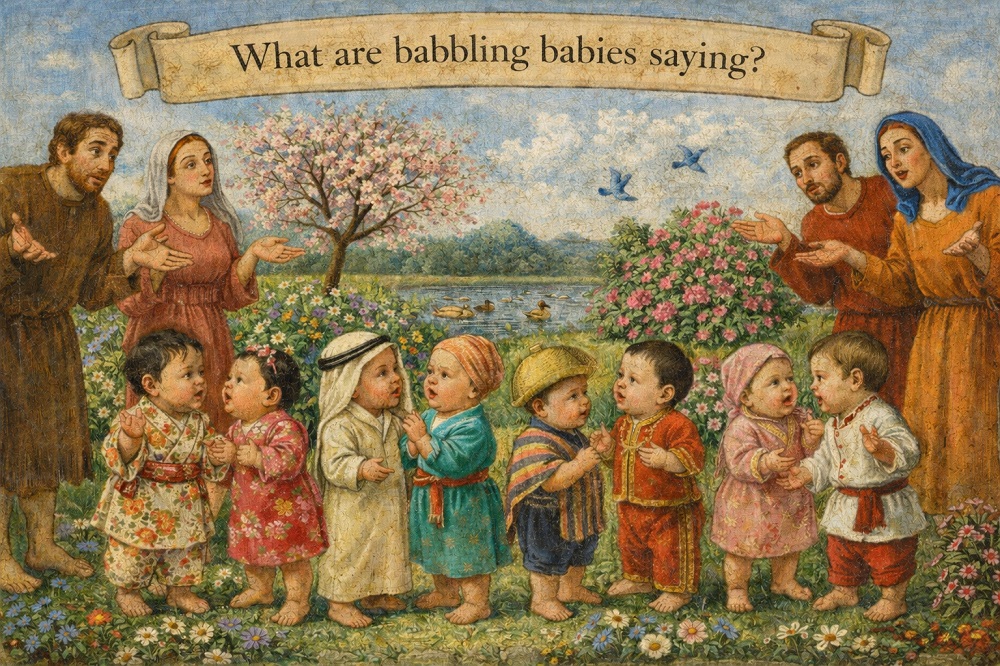
* "I would like every one of you to speak in tongues, but I would rather have you prophesy." -Paul personally knew the benefits of babbling in tongues.
* "He who prophesies is greater than one who speaks in tongues" -Laying down an order based on serving the common good more effectively. I quite comically read a commentary which agrees with Dr. John Lightfoot (a early 17th century churchman, rabbinical scholar, Vice-Chancellor of the University of Cambridge and Master of St Catharine's College, Cambridge) that the tongues they learned was Hebrew and a restoration of the true knowledge of this language. Therefore, Paul is saying that someone who only correctly knows Hebrew, but does not convey its meaning well, is of no use. Funny to me because they were serious. Their error is that they did not recognize and/or accept that there are two different forms and uses of tongues presented in the New Testament.
* "unless he interprets" -A separate gift that the speaker may or not have. If they have (13), then the tongue is more like prophecy than tongues.
* "so that the church may be edified" -Edify is to instruct especially so as to encourage intellectual, moral, and/or spiritual improvement. The original Greek noun is "oikodome", a compound word meaning "build home".
* Edification of the Church.
The basic principle Paul insists on is that whatever is done in congregational meetings must contribute to the edification, that is, building up, of the congregation (3, 5b). He first stated this in 12:7, "Now to each one the manifestation of the Spirit is given for the common good." This also agrees with the previous chapter concerning the way of love. "If I speak in the tongues of men and of angels, but have not love, I am only a resounding gong or a clanging cymbal." (13:1)
What is spoken in congregational meetings, then, must be intelligible to the listeners, in the style and language they would understand, or at least interpreted. Even if the message is in the same language, if it is not in a style and dialect they are familiar with, it could hinder the message.
Years ago, I gave messages in countries where I did not speak the native language, and they did not speak mine. So I was given an interpreter. If I had not used one, my message would not have been received, and so I and my message would have been useless to them. The principle applies to speaking in tongues. Therefore, prophecy that is understood is better than tongues that no one understands.
The message is not only what I say, but how I say it. If a message is to be received, it needs to be conveyed in the best possible way. Communication is more than words. Communication involves dialect, style, and body language. Conviction and heart from the messenger is as much, if not more, of the message as the words. Even actors practice their art before they perform on a stage in front of an audience. Therefore, I should seek the gift of prophecy, present God's messages to other, doing so in a manner that in a way that is best received by the audience. They should fall in love with Jesus, not fall asleep.
Listen to the above comments on 1 Corinthians 14:1-5.
>2. How can speaking in tongues be as important as prophecy? (6)
* 1 Corinthians 14:6 "Now, brothers, if I come to you and speak in tongues, what good will I be to you, unless I bring you some revelation or knowledge or prophecy or word of instruction?"
* "my brothers" -Used 4 times in this chapter. The original Greek noun (masculine) is "adelphos" used 346 times in the New Testament. The Greek word, especially its plural form "adelphoi", can refer to both males and females. While it literally means "brother" or "siblings" (male), it was commonly used in the New Testament to mean "brothers and sisters" or "siblings" generally, particularly within the context of a faith community.
* "what good will I be to you" -It would be useless for a person to speak in tongues unless, by interpretation, he or she brings the congregation something understandable and edifying. (NIV Study Bible)
* "unless I bring you some revelation or knowledge or prophecy or word of instruction?" -These can only happen if they understand what is being said.
>Why was the Corinthian Christian practice of speaking in tongues all wrong? (7-8)
* 1 Corinthians 14:7-8 "Even in the case of lifeless things that make sounds, such as the flute or harp, how will anyone know what tune is being played unless there is a distinction in the notes? Again, if the trumpet does not sound a clear call, who will get ready for battle?"
* "Even in the case of lifeless things that make sounds" -Songs with more than one instrument needs coordination. Even one instrument needs the use of cords and meter. All instruments that makes more than one tone needs to be tuned to one chord.
* "Again, if the trumpet does not sound a clear call, who will get ready for battle?" -Israel in battle played different sounds as did many national armies in those days to direct the solders. (Numbers 10:9; Joshua 6:4, 9)
>How has some modern day congregations followed the Corinthian congregation's error? (9-11)
* 1 Corinthians 14:9-11 "So it is with you. Unless you speak intelligible words with your tongue, how will anyone know what you are saying? You will just be speaking into the air. Undoubtedly there are all sorts of languages in the world, yet none of them is without meaning. If then I do not grasp the meaning of what someone is saying, I am a foreigner to the speaker, and he is a foreigner to me."
* "So it is with you." -They must be understood, what is said must be organized, said one at a time. Paul says this later.
* "Undoubtedly there are all sorts of languages in the world" -Since the tower of Babble.
* "yet none of them is without meaning." -Paul is implying even speaking in tongues must have meaning behind it.
>How might one excel at a spiritual gift? (12)
* 1 Corinthians 14:12 "So it is with you. Since you are eager to have spiritual gifts, try to excel in gifts that build up the church."
* "eager to have spiritual gifts" -All are given at least one gift. We should accept the gift eagerly with gratitude.
* "builds up the church" -Desire and ask for the gift that builds up the church. Paul is thinking about the illustration of a building, like the temple in Jerusalem.
* Intelligible Message.
My mother said to the young me, "If you don't have anything nice to say, don't say anything at all." I do not remember what I was always saying that wasn't nice. Perhaps, she just wanted me to stop talking and let my siblings say something for a change. I do tend to babble on, and what could a young boy say that would be of interest to a working mother with four children and one more on the way?
The Spirit through Apostle Paul says, "If you do not bring some revelation or knowledge or prophecy or word of instruction from God that is understandable, then you should stop speaking in front of the congregation." (6) "You are 'speaking into the air'. Sit down, be quiet, and let others speak who will say intelligible words." (9-11)
Perhaps a parallel exists between the young me, my working mother, the Corinthian congregation, and those who would speak before it. I have been to congregational meetings that ended with people yelling babbles, shouting against the devil, stomping their feet, and making more commotion than any other event I have personally witnessed, all in the name of being led by the Spirit. Their justification for the chaos conflicts with Paul's parallels to organized musical pieces and an army's trumpet call in verses 7 and 8. (Numbers 10:9; Joshua 6:4, 9) As the organized and recognizable notes convey a clear tune and message, so should the proceedings in a congregation's meetings.
I can apply this principle to my life. Am I conveying a clear message about Christ and living his truth in my tune? What would those I trust say: my spouse, parents, children, friends, fellow perishers, and perhaps even my coworkers? Am I a chaos of messages, or do every aspect of my life convey a clear message? Am I like Christ, following his example as is revealed in the gospels?
Listen to the above comments on 1 Corinthians 14:6-12.
>3. If given speaking in tongues what should be my motive in doing it publicly? (13, 16)
* 1 Corinthians 14:13 "For this reason anyone who speaks in a tongue should pray that he may interpret what he says."
* 1 Corinthians 14:16 "If you are praising God with your spirit, how can one who finds himself among those who do not understand say "Amen" to your thanksgiving, since he does not know what you are saying? You may be giving thanks well enough, but the other man is not edified."
* "should pray that he may interpret what he says." -The one who speaks in tongue is the interpreter, therefore they are basically being a prophet, preacher, and teacher.
* "say 'Amen'" -The Hebrew particle indeclinable "Amen" means, "I believe. I agree. That is trustworthy. Let it be. So be it." Amen is said with inflection, a change of tone, increased volume, and pitch with excitement. An "amen" is acceptable to say in a Christian meeting. Some congregation are to stiff and formal because of pride and/or culture to permit the "Amen".
* Paul is saying "consider others". He said this about eating meat offered to idols too.
* "who do not understand" -NIV text note says, "or 'among the inquirers'".
>What should be recognized if done in private? (14-15)
* 1 Corinthians 14:14-15 "For if I pray in a tongue, my spirit prays, but my mind is unfruitful. So what shall I do? I will pray with my spirit, but I will also pray with my mind; I will sing with my spirit, but I will also sing with my mind."
* "For if I pray in a tongue, my spirit prays" -Most everyone moans, groans, weeps, and cries. Humans express emotions through these from birth. Yet, since praying in a tongue with our spirit is a gift of the Spirit, it is more than the expression of emotions. Emotions are connected to the mind. Tongues is connected to our spirits. However, both could be expressed at the same time. The following verses indicate that the prayers Paul is thinking about are prayers of thanksgiving and praise (16-17), such as the apostles on Pentecost when the Holy Spirit was poured out for the first time. (Acts 2)
* "my mind is unfruitful" -Not even the one who speaks tongue understands what they are saying without an interpreter.
* "I will also pray with my mind; I will sing with my spirit" -Both are needed. Jesus said, "True worshipers will worship in spirit and truth," to the Samaritan women by the well.
* "but I will also sing with my mind" -The tongue is usually used, but this can included humming and whistling too. The original Greek verb is "psallo" probably from "psao" which means "to rub or touch the surface", "to twitch or twang", and "to play on a stringed instrument". All the translations that I have render "psallo" as sing here because Paul is speaking about the gift of tongues, thus implies using the human tongue to sing, not a musical instrument
* John 4:21-24 "Jesus declared, "Believe me, woman, a time is coming when you will worship the Father neither on this mountain nor in Jerusalem. You Samaritans worship what you do not know; we worship what we do know, for salvation is from the Jews. Yet a time is coming and has now come when the true worshipers will worship the Father in spirit and truth, for they are the kind of worshipers the Father seeks. God is spirit, and his worshipers must worship in spirit and in truth."
>What did Paul personally practice? (18-19)
* 1 Corinthians 14:18-19 "I thank God that I speak in tongues more than all of you. But in the church I would rather speak five intelligible words to instruct others than ten thousand words in a tongue."
* "I thank God that I speak in tongues more than all of you." -Not publicly. Most likely they did not know.
* "But in the church" -Before the congregation.
* Spirit and Mind.
Prayer, song, praise, and thanksgiving are presented to God personally and congregationally. Prayer is often defined as a formal request, a petition, and simply communion with God. A prayer can be written by someone else. For example, we pray the Lord's Prayer as recorded by the gospel writers. (Luke 11:2-4) We also pray with our mind and heart, as Jesus did during the Last Supper (John 17).
A song has melody and meter. Praise may or may not have melody and meter. Jesus and the apostles sang a traditional Jewish hymn during the Last Supper (Matthew 26:30; Mark 14:26). Thanksgiving is gratitude expressed exclusively to God.
Prayer, song, praise, and thanksgiving can be given from our mind with understandable words through our physical tongue, and from our spirit with unperceivable words through the same physical tongue (13-14). Apostle Paul tells the Corinthian congregation when it is proper to use each. When we are before the congregation, we should edify the mind with perceivable language. The minds of all present should understand what is said. When we are alone, we can pray in a tongue even though our mind does not understand (15-17).
Apostle Paul spoke tongues in private and thanked God for it. I have too. When you are alone and want to praise and thank God, but have no words or lack perceivable language to express your thankfulness and praise, rather than ramble on with repetitive words as the pagans (Matthew 6:7-8), pray and/or sing your praise and thanksgiving with your spirit by the use of tongues if you have that gift. God looks at the heart and sees your offering that comes from the spirit and accepts it.
Listen to the above comments on 1 Corinthians 14:13-19.
>4. What kind of thinking should be part of the Christian life? (20)
* 1 Corinthians 14:20 "Brothers, stop thinking like children. In regard to evil be infants, but in your thinking be adults."
* "Brothers" -This is the second time Paul calls them brothers. The first was in verse 6. See comment there. Paul still calls them brothers in Christ here and in verse 26. They made errors, but were still his brothers. He calls them brothers two more times in the letter (26 and 39).
* "stop thinking like children." -"Thinking" expresses the will of one's spirit as the heart is the will of the soul, the mind. (Romans 8:5-8) They were not mature in Christ, as he said in 3:2. Their thoughts were not like a mature believer in Jesus. Their understanding of gifts of the Spirit and the right use of the gifts were childlike. They were improperly using them to show themselves better than other believers. Therefore, they believed the impressive gifts such as speaking in tongues were better to have when they were actually the least of the gifts because they did not help the congregation. Their actions lacked love for others, childish. The KJV renders "be not children in understanding" and the ASV has "be not children in mind".
They admire, and are astonished at what is striking, novel, and what may be of no real utility. They are pleased with anything that will amuse them, and at little things that afford them play and pastime. So your admiration of a foreign language, and of the ability to speak it, is of as little solid value as the common sports and plays of boys.
Barnes' Notes on the New Testament reads, "It is sometimes well to appeal to Christians in this manner, and to show them that what they are engaged in is unworthy the dignity of the understanding - unfit to occupy the time and attention of an immortal mind. Much, alas! very much, of that which engages the attention of Christians is just as unworthy of the dignity of mind, and of their immortal nature, as were the aims and desires which the apostle rebuked among the Christians at Corinth. Much that pertains to dress, to accomplishment, to living, to employment, to amusement, to conversation, will appear, when we come to die, to have been like the playthings of children; and we shall feel that the immortal mind has been employed, and the time wasted, and the strength exhausted, in that which was foolish and puerile."
* "In regard to evil be infants" -Be childlike, not childish. Jesus often rebuked the disciples for arguing about who was the greatest among them. He used little children to illustrate how they should be in regard to such thinking. (Matthew 18:1-4; Mark 9:33-37; Luke 18:15-17) Paul was using the same illustration. Infants have no evil desires or wrong motives in wanting to be greater than their siblings nor to excel in spiritual gifts (such as speaking in tongues) as an end in itself.
* "but in your thinking be adults." -Love others as mature believes in Jesus should. Think about the welfare and good of others instead of self.
* Romans 8:5-8 "Those who live according to the sinful nature have their minds set on what that nature desires; but those who live in accordance with the Spirit have their minds set on what the Spirit desires. The mind of sinful man is death, but the mind controlled by the Spirit is life and peace; the sinful mind is hostile to God. It does not submit to God's law, nor can it do so. Those controlled by the sinful nature cannot please God."
* Matthew 10:16; Romans 16:19; Ephesians 4:14
>How does the word of God support the use of tongues and prophecies? (21-22)
* 1 Corinthians 14:21-22 "In the Law it is written: "Through men of strange tongues and through the lips of foreigners I will speak to this people, but even then they will not listen to me," says the Lord." Tongues, then, are a sign, not for believers but for unbelievers; prophecy, however, is for believers, not for unbelievers."
* The passage from Isaiah 28:11-12 indicates that the foreign language of the Assyrians was a sign to unbelieving Israel that judgment was coming on them. Paul deduced from this fact that tongues were intended to be a sign for unbelievers, as in Acts 2:4-14. Similarly, prophecy was for believers since it communicated revealed truth to those disposed to receive it (Matthew 13:11-16). (NIV Study Bible)
* "In the Law it is written" -Historically many Jewish scholars would not include Isaiah, nor any of the prophets under the classification of the law. They would say the Law is the Covenant, and that is the first five books of the Bible, written by Moses as inspired by the Lord concerning the covenant at Mount Sinai. Yet, the prophets expounded on the law as history of the Jews continued from that time. Paul, in Romans 3:10-19 quotes from a number of passages from the Old Testament, including Isaiah, also collectively calls them "the law".
* "Tongues, then, are a sign, not for believers but for unbelievers" -A confirmation, as discussed in 1c comments where three examples are given from Acts that predate Paul's starting of the congregation at Corinth.
Here, Paul is saying, their motives in using the gift of tongues in the congregational meetings have the wrong motives. They are using it as a sign to others long after all who are present already know that the speaker is a Christian. After conversion has been confirmed by speaking in tongues, Paul told them that it is good to use this gift in private, for he does, not they should not use it in public. Some charismatic congregations do not follow Paul's rebuke in this passage.
* "That gifts may be rightly used, it is proper to know the ends which they are intended to serve. To go about the conversion of infidels, as the apostles did, had been a vain undertaking without the gift of tongues, and the discovery of this gift; but, in an assembly of Christians already converted to the Christian faith, to make use and ostentation of this gift would be perfectly impertinent, because it would be of no advantage to the assembly; not for conviction of truth, because they had already embraced it; not for their edification, because they did not understand, and could not get benefit without understanding, what they heard." (Matthew Henry's Commentary on the Whole Bible)
>5. Who should we consider when we conduct a worship service? (23-24a)
* 1 Corinthians 14:23-24 "So if the whole church comes together and everyone speaks in tongues, and some who do not understand or some unbelievers come in, will they not say that you are out of your mind? But if an unbeliever or someone who does not understand comes in while everybody is prophesying..."
* "some who do not understand" (23) -NIV text note says, "or some inquirers". They heard about some aspect of Jesus and the gospel and came inquiring about it.
* "some who does not understand" (24) -NIV text note says, "or or some inquirer". They heard about some aspect of Jesus and the gospel and came inquiring about it.
* "some unbelievers" -Those who have made no movement toward saving faith. The context is a meeting of the congregation in which everyone is speaking in tongues at once with the result that general confusion and chaos reigns.
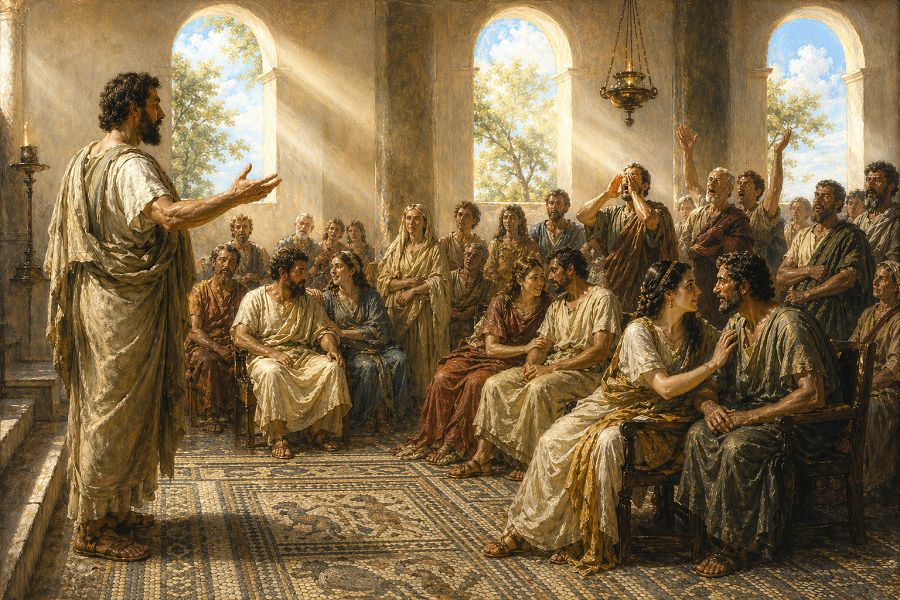
* "out of your mind" -One of the responses at Pentecost was some believed the disciples were drunk. Similarly, if the whole Corinthian congregation were speaking in tongues all at once, the visitor will be repulsed by the chaos and confusion, and so the phenomenon meant to be an impressive sign will have a negative effect on the individual who was making an inquiry. They would conclude, "I want to have nothing to do with madness."
>What should be the outcome of an unbeliever if he is brought or enters our worship service? (24b-25)
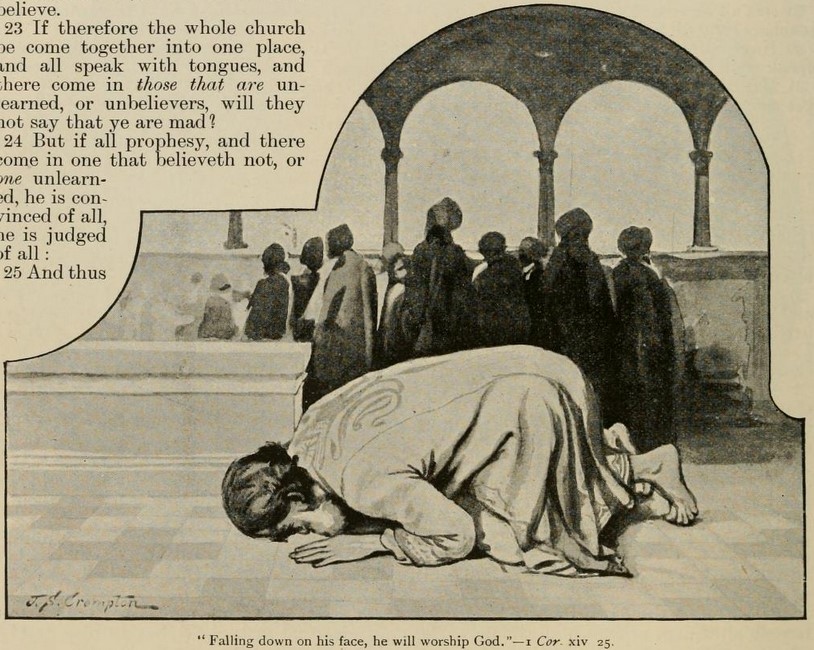
* 1 Corinthians 14:24b-25 "...he will be convinced by all that he is a sinner and will be judged by all, and the secrets of his heart will be laid bare. So he will fall down and worship God, exclaiming, "God is really among you!"
* "he will be convinced by all that he is a sinner and will be judged by all," -Convicted through all their teachings concerning Jesus during the meeting. The Holy Spirit is leading them to speak and working on the heart of the person inquiring about their faith in Jesus. "His conscience is aroused and awed by this united testimony to truth" per Massie.
* "convinced" -Also in John 16:8 translated as, "When he comes he will convict the world of guilt in regard to sin and righteousness and judgment." The Holy Spirit gives a deep depravity of sin that can lead to repentance and righteousness through Jesus.
* "secrets of his heart will be laid bare." -Paul wrote earlier that the Holy Spirit searches the deep things of the heart. Here, they are "laid bare" to himself and those who witness to him. The conviction is seen in the demeanor as much as any confession that is made verbally.
* "fall down and worship God" -The universal position of reverence and worship.
* John 16:7-11 "But I tell you the truth: It is for your good that I am going away. Unless I go away, the Counselor will not come to you; but if I go, I will send him to you. When he comes, he will convict the world of guilt in regard to sin and righteousness and judgment: in regard to sin, because men do not believe in me; in regard to righteousness, because I am going to the Father, where you can see me no longer; and in regard to judgment, because the prince of this world now stands condemned."
* Stop Childish Thinking.
Apostle Paul, inspired by the Holy Spirit, concludes his correction to the Corinthian believers concerning speaking in tongues during their meetings with a sharp rebuke. His rebuke mimics Jesus' rebuke to the apostles concerning their childish arguments about who was the greatest. "I tell you the truth, unless you change and become like little children, you will never enter the kingdom of heaven. Therefore, whoever humbles himself like this child is the greatest in the kingdom of heaven." (Matthew 18:1-4; Mark 9:33-37; Luke 18:15-17)
Paul wrote, "Brothers, stop thinking like children. In regard to evil be infants, but in your thinking be adults." (20) The Corinthian believers, like the apostles, had childish thinking that sought human recognition and conformity. The mature in Christ in love think about how to seek the welfare of others even at the expense of self.
Paul directs their selfish, childish thoughts towards someone who comes to their meetings with inquiries about Jesus and the gospel. If that person were to come in and see all them speaking at one time in a strange language, the chaos and confusion would have the same response as at Pentecost, "These people are drunken mad!" They would quickly leave. However, if someone speaks in clear language and with honest emotion about the gospel, they will come to faith in Jesus and repent.
So what of my thinking? Is it mature or childlike? Do I heed Jesus serious rebuke? Do I in love think about how others will see my actions? Does all of me prophesy? (24)
Listen to the above comments on 1 Corinthians 14:20-25.
>6. How did personal enthusiasm get out of control in the Corinthian worship services? (26)
* 1 Corinthians 14:26 "What then shall we say, brothers? When you come together, everyone has a hymn, or a word of instruction, a revelation, a tongue or an interpretation. All of these must be done for the strengthening of the church."
* "brothers" -The original Greek noun (masculine) is "adelphos" used 346 times in the New Testament. The Greek word, especially its plural form "adelphoi", can refer to both males and females. While it literally means "brother" or "siblings" (male), it was commonly used in the New Testament to mean "brothers and sisters" or "siblings" generally, particularly within the context of a faith community.
* "everyone...anyone... someone" -Not just a select few leaders.
* "come together" -Paul never calls it a worship service, mass, church, or any of the modern terms used to denote a congregation coming together. He only says, "when you come together", twice adding, "as a church." (11:18, 20, 33. 14:23, 26) All the English translations have "come together" except God's Word (GW) has "gather". The Greek is the verb "synerchomai" (a transliteration) primarily means "to come together," "to assemble," or "to gather". It is a compound verb formed from "syn" (together) and "erchomai" (to come/go).
* "a hymn... a word of instruction, a revelation, a tongue or an interpretation" -The emphasis, as in chapter 12, is on the diversity and complementary nature of spiritual gifts (i.e. 12:5) and they should be used when they come together.
* "All of these must be done for the strengthening of the church." -Paul repeats himself using different words. He uses the same Greek noun "oikodome" as verse 5. The NIV has "strengthening of the church". The NIV is the only translation I have that adds "of the church". A word for "church" is not in the original Greek, but it is implied. Others end the sentence "for building up", "to help each other grow", "be done for edification", "be done unto edification", and "be done to build each other up".
>7. What kind of personal control must a person have if they have the gift of tongues? (27-28)
* 1 Corinthians 14:27-28 "If anyone speaks in a tongue, two--or at the most three--should speak, one at a time, and someone must interpret. If there is no interpreter, the speaker should keep quiet in the church and speak to himself and God."
* Order and patience are needed.
* An interpreter is needed.
* Not only with this stop chaos, but it will stop fraud and pride.
* Humility is needed.
>What kind of personal control must a person have if they have the gift of prophecy? (29)
* 1 Corinthians 14:29 "Two or three prophets should speak, and the others should weigh carefully what is said."
* Order and patience are needed.
* "others" -Observation and investigation from "others" might be meant by verse 29. Who those "others" are is not stated in verse 29. However, verse 32 might be giving direction. Either the investigation is to be given by other prophets, or most likely the gift of prophecy (as tongues needs control) should be controlled by the recipients of the inspiration themselves (15, 26-32).
* If a prophet or teacher rambles on and does not let others speak, stop going to their gatherings. Their pride will block the Holy Spirit's inspiration.
* Humility is needed.
>What kind of mutual respect should a speaker and a listener have? (30-31)
* 1 Corinthians 14:30-31 "And if a revelation comes to someone who is sitting down, the first speaker should stop. For you can all prophesy in turn so that everyone may be instructed and encouraged."
* "the first speaker should stop" -Takes humility, trust in God, and control of thought.
* "For you can all prophesy in turn"
* "so that everyone may be instructed and encouraged."
>8. What does verse 32 mean?
* 1 Corinthians 14:32 "The spirits of prophets are subject to the control of prophets."
* Addressed in part in commentary in question 7b.
* "spirits of the prophets" -"Spirit" in the original Greek is the noun "pneuma" (a transliteration) discussed earlier in commentary. "Prophets" in the original Greek in both places is the noun "prophetes" discussed earlier in commentary means "inspired speaker.
* "subject to the control of the prophets" -"Subject" in the original Greek is the verb "hypotasso" meaning "being under" and "being obedient".
* Some say this means that either the individual prophesying, or allegedly prophesying, has control over how and/or when he is delivering prophecy. Others say it means that other prophets are to oversee and/or check what they say, as Paul says he wants others to do with his writings in verse 37, and what the Apostle John wrote, "Dear friends, do not believe every spirit, but test the spirits to see whether they are from God, because many false prophets have gone out into the world" (1 John 4:1).
Although the later is plausible, the former is most likely to be applied here based on the context and 2 Peter 1:21, "For prophecy never had its origin in the will of man, but men spoke from God as they were carried along by the Holy Spirit." Apostle Peter is saying the inspiration coming to an individual was the will of God, and still we know that the prophets were able to control when they spoke. Consider prophets who saw visions or had dreams that were messages. Did not they restrain giving it till the time was right, when they were in the right place and with the right people? Jonah, of all prophets is an exmple. He was given God's message. Yet, he did not deliver the message right away, and he went the other direction. Eventually, he obeyed. The point is Jonah, a prophet, was able to refrain from giving the message for several days. Apostle Paul is saying, "You can speak one by one. You can restrain yourselves for a little while, even an hour before you speak, till the other prophet is done speaking."
>What is the conclusion about way to conduct a worship service? (33a)
* 1 Corinthians 14:33a "For God is not a God of disorder but of peace."
* "For God is... a God... of peace" -"God" is "Theos" (a transliteration) in the original Greek. Paul often refers to God as the God of peace near the end of his letters (Romans 15:33, 16:20; 1 Thessalonians 5:23; 2 Thessalonians 3:16; 2 Corinthians 13:11; Philippians 4:9)
The KJV renders the Greek, "For God is not the author of confusion, but of peace..." The italics are in the KJV to note "the author" is not in the original manuscripts. The ASV is the same as the NIV except it has "confusion" instead "disorder" and has "a God" in italics. GW, the CSB, and HCSB are the same as the NIV (except God's Word sentence structures repeats "God" three times.). YLT is the same as the NIV except it has "tumult" instead of "disorder" and it has "a God" in italics. The KJV italics indicates that "the author", as others do for the second "God", is not in the original Greek. English sentance structure needs either "the author" or a second "God" because the noun, or noun phrase, acts as part of the subject complement (predicate nominative) describing the main subject the first "God" in the sentence.
* Not a God of Disorder.
Apostle Paul was concerned that disorderly and unregulated congressional meetings at Corinth would discredit the name of the God who had called those in Christ to peace and unity (33; 10:11-13). He gave them orderly instructions for speaking in tongues, and that only if there is an interpreter (26-28). He gave them orderly instructions for prophets, and that their every word should be weighed carefully (29-32).
God is a God of order and peace. Order exists in DNA and the cell though they are complex. Order exists in the atom and the solar system though they are complex. Order exists in geology and nature though they are complex. Edward Lorenz discovered that order exists within chaos theory. In 1961, while simplifying weather prediction models, he developed a set of three nonlinear differential equations-now known as the Lorenz system-which demonstrated that chaotic, unpredictable systems follow a "strange attractor" that forms a distinct pattern resembling a butterfly (Remember that when we get to chapter 15 overview.).
When a congregation comes together, the proceedings should have order and peace, even though they are complex. Family life is complex, but that doesn't mean that it should be void of at least some order and peace. How? Through Jesus, the Prince of Peace. Jesus said, "Come to me, all you who are weary and burdened, and I will give you rest. Take my yoke upon you and learn from me, for I am gentle and humble in heart, and you will find rest for your souls. For my yoke is easy and my burden is light." (Matthew 11:28-30)
Yesterday's blue morning, followed by today's gray. Tomorrow we pray, the Son to split open the sky.
Listen to the above comments on 1 Corinthians 14:26-33a.
>9. Why might the direction in verses 33b-35 be given?
* 1 Corinthians 14:33b-35 "As in all the congregations of the saints, women should remain silent in the churches. They are not allowed to speak, but must be in submission, as the Law says. If they want to inquire about something, they should ask their own husbands at home; for it is disgraceful for a woman to speak in the church."
* Jesus interaction with women was revolutionary in first century Jewish society. The many inclusions of women of faith in the gospels reveal the misconception first century Jewish society (and other ancient societies) had about God's love and intent for women.
* "As in all the congregations of the saints" -One philosophical group called the Skeptics (The primary philosophical group known as the Skeptics in the first century were the Pyrrhonists, following the tradition of Pyrrho of Elis. They practiced epoche (suspension of judgment) to achieve inner peace, or ataraxia. While Academic Skepticism was influential earlier, first-century skeptics focused on questioning whether dogmatic knowledge is possible.) rejected all arguments except an almost universally accepted one: the argument from custom "that's just not the way it is done." By starting (his conclusion) with this statement that is what Paul seems to be saying. He starts his (perhaps his concluding) argument with this statement, and then picks it up again in verse 36-38.
* "women should remain silent in the churches... as the Law says" -Enforced in Jewish synagogues based on the fact that women were assigned by the Lord God a separate place in the temple courts. The first area in the temple courts only allowed priests. The next outer were only Israelite men. The third outer was Israelite women. The largest and most outer was for any Gentile, male and female. The Old Testament does not say anything about children under the age of twelve that I recall, except that they were brought in by the parents to fulfill certain rites of passage at different ages (consider Jesus' life). However, the Jewish leader requirement that women should remain silent in the synagogue based on the temple (if in fact that is what they did) is not Biblical. See below.
* "They are not allowed to speak... as the Law says" -Biblical law (the Old Testament, which is all they had at this time, only deals with the Temple for synagogues are not mentioned because they started after the Old Testament was finished and closed) includes no specific text that enjoins silence or submission on women, or anyone, in the Temple. Although Paul could refer back to his creation argument in 11:8-9, or to the effects of the curse in Genesis 3:16.
Apostle Paul can also use "law" generally as he does in 14:21 which is a quote from Isaiah, not the Mosaic Law.
Thus, here Paul could be referring only to the generally subordinate position of women in Old Testament times. On this reading, Paul counters an objection of Corinthian prophetesses, who do not think they should be in subjection. Although Paul may not believe they should be subjected in all cultures, that women prophetesses were in the Old Testament period suggests that it is not wrong for them to be submissive in some cultural settings.
According to another view, Paul cites the Corinthians' view in 14:34-35, and refutes it in 14:36. Others object that 14:36 is too weak to supply a refutation for 14:34-35.
(Some of the above is from me based on Bible Background Commentary - The IVP Bible Background Commentary - New Testament. Though I added to and changed to wording to make it easier to comprehend, clarify, and correct, I do not necessarily agree with everything they wrote, as with some other quotes I give on the site I supply comments that should be considered. My understanding is below.)
* "but must be in submission... as the Law says." -See comments on 11:2-16 in Study 8 commentary. Some believe that in light of 11:3 there is God-ordained order that is to be the basis for administration and authority. Women are to be submission to their husbands both at home (Ephesians 5:22) and in the church (1 Timothy 2:11-12) regardless of their particular culture. According to this view, a timeless order was established at creation. See comments on 11:5-6 in Study 8 comments.
Others maintain that Paul's concern is that the church be strengthened (26) by believers showing respect for others (30-31) and for God (33) as they exercise their spiritual gifts. Such respect must necessarily take account of accepted social practices. If within a particular social order, it is disgraceful for a woman to speak in church - and it was in this case (35) - then she shows disrespect by doing so and should remain silent. There were occasions, though - even in this culture - for women to speak in church. For example in 11:5 Paul assumes that women pray and prophecy in public worship. Thus his purpose, according to this view, was not to define the role of women but to establish a fitting (34-35) and orderly (27-31) way of worship (40).
Still others say that in this context Paul is discussing primarily the disruption of worship by women who become involved in noisy discussions surrounding tongues-speaking and prophecy. Instead of publicly clamoring for explanations, the wives were to discuss matters with their husbands at home (35). Paul does not altogether forbid women to speak in church (11:5). What he is forbidding is the disorderly speaking indicated in these verses. (NIV Study Bible)
* "as the Law says." -The Old Testament does not include a specific passage that directly and exactly says that women cannot speak or be submissive as the New Testament does. All commentaries I have, refer to Genesis at creation and/or the curse as a result of the fall because Paul refers to Genesis in chapter 11:8-9. Consider verse 21 where the Holy Spirit reveals a sublime meaning of Isaiah.
* "If they want to inquire" -The original Greek is "Ei thelo manthano" (a transliteration). "Ei" in a conjunction used 292 times in the New Testament. "Thelo" is a verb used 210 times in the New Testament. "Manthano" is a verb used 25 times in the New Testament.
* "about something" -The original Greek pronoun is "tis" (a transliteration) used 448 times in the New Testament.
* "they should ask their own husbands at home" -The original Greek starts with the verb "eperotao" used 59 times in the New Testament from "epi" and "eroao" meaning "to ask for", "to inquire, seek", and "to ask a question" often implying a pointed, urgent, or challenging inquiry demanding an answer, often used in associate of interrogating Jesus. A second use is to consult or seek God's will. (Mark 9:32; Matthew 22:35; Romans 10:20) The next Greek word in the adjective "idios" used 113 times pertaining to self, one's own, by implication private or separate. The third Greek word is the noun "aner", a primary word meaning "husband" and "sir". The last two words are "en oikos" meaning "at home".
* "ask their husbands at home" -The image given is as a prophet or teaching is presenting in the front, a wife would turn to her husband and ask him a question expecting a demand. A conversation ensures, disrupting those around them.
* "for it is disgraceful for a woman to speak in the church." -11:5 seems to allow women to speak when the congregation meets, while this passage says it is disgraceful. However, they are different circumstances. 11:5 concerns praying and prophesying. These verses, 33b-35, are about having a side conversation with someone, whether about the subject someone is speaking about or an entirely different subject. Paul's wording in verse 35 is, "If they want to inquire about something..." Praying and revealing a word from the Lord is not inquiring about something. Someone may state, "Men do this too." I have not witnessed in over 60 years men starting a separate side conversation or asking the person next to them a question unless they intended to be rude to the speaker. However, it is possible that there exists men who without ill intent to the speaker will start a side conversation with their wife while someone is speaking to the group they are in.
>How might these verses be applied in a congregation today?
* Shhh... Separate Discussions Are Rude.
Have you ever been to a play, movie, or presentation where there were disruptions? Paul addresses in verses 26-40 rude people being boisterous and obnoxious in a congregational gathering designed for one person to speak. "What then shall we say, brothers? When you come together, everyone has a hymn, or a word of instruction, a revelation, a tongue or an interpretation." (26b) Many were speaking at once, which isn't right (27, 30). It sounded like a large flock of seagulls on a rocky ocean beach with waves crashing.
First, he tells them to no longer simultaneously speak in tongues and prophecy during their gatherings (26-33). Only one person is to speak in front of the congregation at a time.
Now Apostle Paul addresses interruptive side conversations, specifically mentioning wives. Paul is not contradicting his statement in 11:5, "And every woman who prays or prophesies with her head uncovered dishonors her head--it is just as though her head were shaved." Women can pray and prophesy during congregational meetings.
When Paul says "women should remain silent in the churches" (34), he specifies that his statement concerns "if they want to inquire about something". The original Greek word "eperotao" is used more often implying a pointed, urgent, or challenging inquiry demanding an answer. It is often used in association with people interrogating Jesus. (Matthew 22:35) Here, it is women asking questions.
Who are the women asking demanding questions and expecting an answer? Paul continues, "they should ask their own husbands at home" (35). The scene is this. One speaker, a prophet or teacher, is up front, and a wife turns to her husband and asks a question. What is her husband going to do? Any wise husband would answer. And so this side conversation interrupts those around them. Tell me you haven't experienced this in a play, movie, classical concert, presentation, or church? I experienced it just last week during a Bible study.
Everyone, please be respectful. Silence your cell phones and stop the side conversations! Let the rest of us hear what we came to hear!
Listen to the above comments on 1 Corinthians 14:33b-35.
>10. What should all congregations remember and publicly acknowledge? (36-37)
* 1 Corinthians 14:36-37 "Did the word of God originate with you? Or are you the only people it has reached? If anybody thinks he is a prophet or spiritually gifted, let him acknowledge that what I am writing to you is the Lord's command."
* The flow of argument started with Paul's statement "As in all the congregations of the saints..." in verse 33b. There he is saying, "This is nothing new in the body of Christ," the same as the two rhetorical questions in verse 36. The instructions about a wife making inquires to her husband as someone is speaking is a seperate point in the middle of his more general argument point that the Corinthian congregation have started to do their own things, separate of other congregations.
* "Did the word of God... Or are you the only people...?" -Paul asks these two rhetorical questions sarcastically, suggesting that the Corinthians were following their own practice in these matters rather than conforming to God's word.
* "let him acknowledge that what I am writing to you" -Paul is not afraid of being peer reviewed. Of course, he was use to others calling him an heretic.
* "the Lord's command." -Consider this all either all that is stated about the subject started in chapter 12, or all of the letter.
>Why?
* 1 Corinthians 14:38 "If he ignores this, he himself will be ignored."
* NIV text note states, "Some manuscripts 'If he is ignorant of this, let him be ignorant.'"
* This is Paul saying, "I am done putting forth any more argument on this subject. I have given enough logical proof. If some still will not change, I will do no more to persuade him. If some are not wishing to recognize these ordinances and my apostolic authority in enjoining them, then it is on them. There is a time to stop. Jesus stopped preaching to the Jewish leaders after three and a half years. Then, he pronounced woes.
*
>What are the three directives we should follow then? (39-40)
* 1 Corinthians 14:39-40 "Therefore, my brothers, be eager to prophesy, and do not forbid speaking in tongues. But everything should be done in a fitting and orderly way."
* "my brothers" -This is the fourth time Paul calls the congregation at Corinth brothers in this chapter. The original Greek noun (masculine) is "adelphos" used 346 times in the New Testament. The Greek word, especially its plural form "adelphoi", can refer to both males and females. While it literally means "brother" or "siblings" (male), it was commonly used in the New Testament to mean "brothers and sisters" or "siblings" generally, particularly within the context of a faith community.
*
* Consistency Per Culture.
Apostle Paul's conclusion to chapters 12-14 begins with verse 33b, "As in all the congregations of the saints.", then it skips to verses 36-40. Paul was saying in verse 33b, "Coming together as a church and the conduct during the meeting is an established pattern in the body of Christ in Asia Minor. Your congressional meetings are different from every other congregation."
Paul's instruction that a wife should not make inquiries to her husband while someone is speaking is between 33b and 36-40. Was Paul's thought interrupted? I am not sure. It seems the different translations don't know where to put 33b either. (First-century Greek had no punctuation. So, translators do not know if 33b is the end of 33a, the beginning of 34, or the start of a thought that picks up again at verse 36.)
The two rhetorical questions in verse 36 have the same concept as verse 33b. "Did the word of God originate with you? Or are you the only people it has reached?" The answer is no. The word of God originated many millennia ago and has continued unbroken to this day. The word of God has spread to many people, including many congregations is Asia Minor.
Paul's general conclusion is that the Corinthian congregation has started to do their own thing, separate from their neighboring congregations in Asia Minor. Paul writes, "Everything should be done in a fitting and orderly way" (40). He meant, as it is done in all the other congregations.
Consider Paul's two rhetorical questions carefully (26). God's word and church tradition have existed unbroken by the power of God to this day. The Word of God has been passed down to us through ancient documents, maintained by God's power. God keeps the long history of the Bible and the church.
New false so-called Christian groups say that only they have the true Bible and religion. They say that all other translations are from broken manuscripts generated in the mid-fourth century. They say the original documents were lost and changed. They say the tradition we have, as Paul wrote, calling it tradition, is wrong. They have no proof of this. I have seen the proof that shows they are wrong. If they are willingly ignorant, let them be ignorant and ignored by God. Do not be fooled by people who say, "An angel told our founder the true way."
Listen to the above comments on 1 Corinthians 14:36-40.